
Meta Description
Explore NASA’s Titan submarine mission concepts for 2026, designed to navigate Saturn’s methane and ethane seas, study Titan’s mysterious environment, and search for potential signs of life.
Introduction
Titan, Saturn’s largest moon, is one of the most intriguing bodies in the solar system. Covered in methane lakes, seas, and rivers, it presents a unique opportunity to study an alien environment with processes similar to Earth’s water cycle.
In 2026, NASA plans to advance Titan submarine mission concepts — robotic submarines capable of exploring the moon’s liquid hydrocarbon seas, analyzing chemical composition, and searching for clues about prebiotic or even microbial life. These missions could redefine our understanding of ocean worlds and extraterrestrial habitability.
Why Titan Is Unique
Titan stands out in the solar system for several reasons:
Hydrocarbon Seas: Titan has liquid methane and ethane seas, the largest outside Earth.
Thick Atmosphere: A nitrogen-rich atmosphere with organic compounds creates complex chemistry.
Surface and Liquid Interactions: Rivers feed lakes, and seasonal changes create dynamic environments.
Potential for Life: While not water-based, Titan’s seas may host prebiotic chemistry or life forms adapted to hydrocarbons.
NASA’s interest in Titan is fueled by the moon’s potential as a natural laboratory for understanding chemical evolution and planetary processes.
NASA’s Titan Submarine Mission Concepts
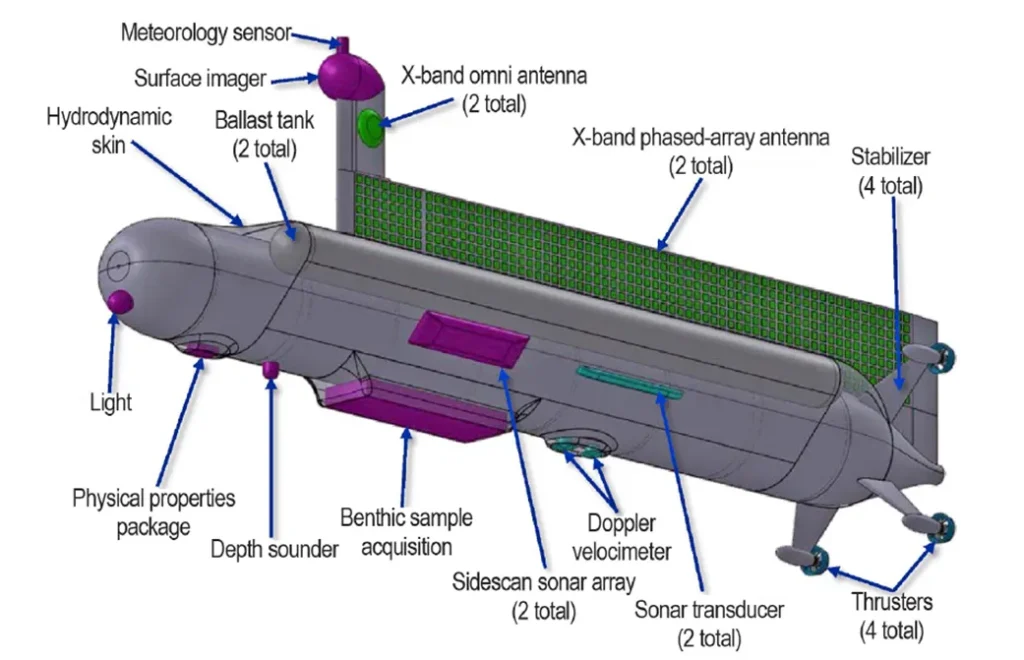
NASA has developed conceptual designs for autonomous submarines to navigate Titan’s seas. Some key elements include:
Submersible Design
Compact and durable to withstand extreme cold (-179°C / -290°F)
Equipped with propulsion systems suitable for low-density methane-ethane liquids
Sensors to measure chemical composition, temperature, and salinity
Communication Systems
Submarine communicates via relay buoys or orbiting spacecraft
Autonomous navigation and data collection required due to signal delay and Titan’s dense atmosphere
Scientific Instruments
Spectrometers for analyzing organic molecules
Cameras and sonar to map underwater landscapes
Environmental sensors to measure pressure, temperature, and currents
These tools will allow scientists to study the chemistry, geology, and potential habitability of Titan’s seas.
Scientific Goals of Titan Submarine Missions
NASA’s 2026 mission concepts aim to:
Characterize Titan’s Seas: Map depth, temperature, and chemical composition of liquid methane and ethane.
Search for Organic Molecules: Detect prebiotic chemistry or potential biosignatures.
Study Surface-Liquid Interactions: Understand how Titan’s rivers, lakes, and seas interact.
Advance Autonomous Technology: Develop robotics capable of operating in extreme, alien environments.
These goals could provide critical insights into both Titan and other ocean worlds in the solar system.
Challenges of Titan Exploration
Exploring Titan’s seas is extremely challenging due to:
Extreme Cold: Electronics, batteries, and mechanical systems must survive -179°C.
Communication Delays: Signals take over an hour to reach Earth.
Unknown Sea Conditions: Titan’s seas may contain currents, waves, or submerged hazards.
Autonomous Operations: Submarine must operate independently with minimal human intervention.
NASA is exploring advanced materials, AI-driven navigation, and robust energy systems to overcome these challenges.
Future of Titan Submarine Exploration
NASA envisions that by the late 2020s and 2030s:
Submersible missions could explore Kraken Mare, the largest sea on Titan
Data collected could inform future landers or aerial drones
Combined with orbital reconnaissance, we could obtain a complete picture of Titan’s hydrology, chemistry, and potential habitability
These missions will expand our knowledge of ocean worlds and offer a glimpse into alien chemistry that might parallel early Earth processes.
Impact of Titan Submarine Missions
Exploring Titan’s seas has far-reaching scientific and technological implications:
Astrobiology: Titan offers a laboratory to study alternative life-supporting chemistries.
Planetary Science: Helps us understand methane-based cycles and surface-liquid interactions.
Engineering Innovation: Advances autonomous underwater robotics in extreme conditions.
Inspiration: Engages the public and fuels interest in space exploration and STEM fields.
Conclusion
NASA’s Titan submarine mission concepts 2026 represent a bold leap into uncharted alien seas. By navigating methane and ethane oceans, studying organic chemistry, and searching for signs of life, humanity takes another step toward exploring the diverse and mysterious worlds of our solar system.
Titan may be a distant, icy moon, but its seas could hold the answers to some of our most profound questions: How does life arise? And what forms could it take beyond Earth? 🌌🌊