
Meta Description
Explore NASA’s Kuiper Belt explorer proposals for 2026, designed to study icy worlds, dwarf planets, and distant Kuiper Belt Objects beyond Pluto, advancing our understanding of the solar system’s frontier.
Introduction
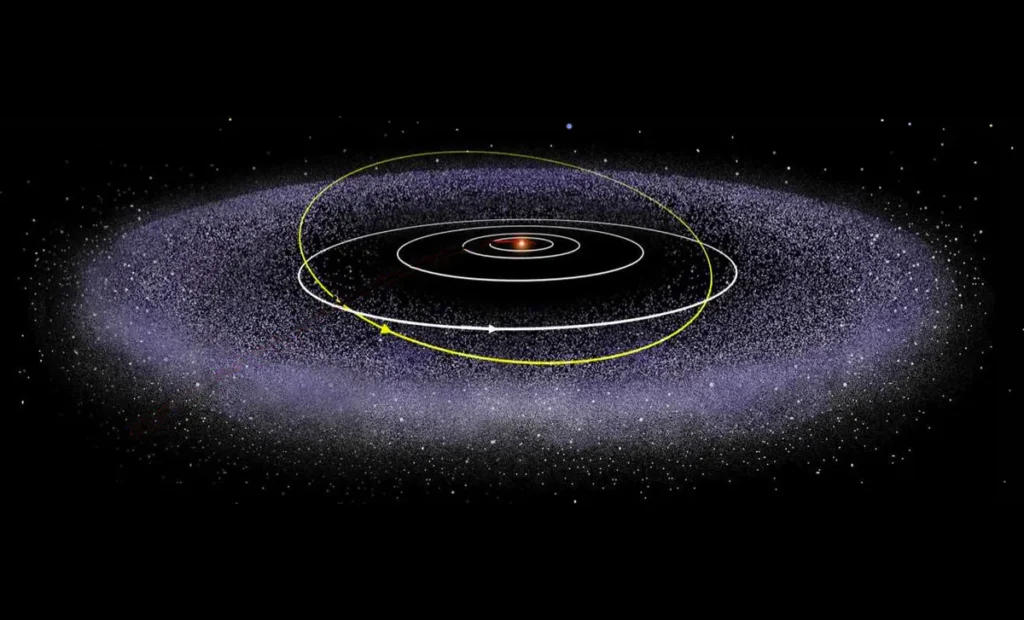
The Kuiper Belt, a vast region of icy bodies beyond Neptune, represents the final frontier of the solar system. Home to Pluto, Eris, and countless smaller objects, it holds clues about planetary formation and the early solar system.
In 2026, NASA plans to evaluate Kuiper Belt explorer proposals, aiming to send next-generation spacecraft to study these distant worlds, uncovering their composition, geology, and evolution. These missions promise to transform our understanding of the solar system’s outer edge.
Why Explore the Kuiper Belt?
The Kuiper Belt is scientifically valuable because:
Pristine Ancient Bodies: Kuiper Belt Objects (KBOs) are remnants of the solar system’s formation over 4.5 billion years ago.
Diverse Worlds: Icy bodies, dwarf planets, and moons with unique surfaces and atmospheres.
Clues to Planetary Migration: The arrangement of KBOs can reveal Neptune’s migration history.
Potential for Discovery: Unknown moons, rings, and distant objects await exploration.
Exploring the Kuiper Belt allows scientists to understand the origins of our solar system and compare it to exoplanetary systems.
NASA Kuiper Belt Explorer Proposal Concepts
NASA is reviewing several mission concepts for 2026 to explore the Kuiper Belt:
Flyby Missions
Build on the success of New Horizons
Rapid reconnaissance of multiple KBOs and dwarf planets
Instruments include high-resolution cameras, spectrometers, and particle analyzers
Orbital Missions
Extended observation of a single KBO or dwarf planet
Allows detailed mapping of surface features, atmosphere (if any), and potential cryovolcanism
Could deploy small landers or probes in the future
Multi-Target Explorers
Spacecraft designed to visit several KBOs in a single mission
Optimized trajectory to maximize encounters
Uses advanced propulsion and autonomous navigation
Advanced Instrumentation
Spectrometers for surface and atmospheric composition
Imaging systems for geological mapping
Particle detectors to study solar wind interactions
Radar to probe subsurface structures
These concepts are designed to maximize scientific return from distant, icy worlds.
Scientific Goals of Kuiper Belt Explorer Missions
Surface and Geology: Study craters, mountains, ice plains, and potential cryovolcanoes.
Composition Analysis: Determine surface ices, organic molecules, and minerals.
Atmospheric Studies: Detect thin atmospheres or transient gas emissions on KBOs.
Solar System History: Understand planetary formation and migration patterns.
Comparative Planetology: Compare KBOs with Pluto, other dwarf planets, and small icy moons.
These objectives help scientists answer fundamental questions about the outer solar system and its evolution.
Challenges of Exploring the Kuiper Belt
Extreme Distance: KBOs are billions of kilometers from Earth; travel times are long, and communication delays are significant.
Power Constraints: Solar power is limited; missions rely on radioisotope thermoelectric generators (RTGs)
Unknown Terrain: KBOs may have rugged surfaces, ice ridges, or volatile materials.
Navigation: Precise trajectory planning is critical to reach multiple distant targets.
NASA is addressing these challenges with advanced propulsion systems, autonomous navigation, and long-lived power sources.
Impact of Kuiper Belt Exploration
Exploring the Kuiper Belt will have significant implications:
Planetary Science: Provides insight into primordial solar system conditions.
Astronomy and Astrophysics: Helps model planetary formation and migration.
Technology Innovation: Advances spacecraft design, autonomous systems, and deep-space communication.
Public Engagement: Inspires curiosity about the distant solar system and space exploration.
By studying the Kuiper Belt, humanity gains a window into the origins and diversity of planetary systems.
Future Prospects Beyond 2026
NASA’s vision includes:
Follow-up missions to high-priority KBOs identified during initial exploration
Potential landers or orbiters for in-depth study of select dwarf planets
Synergy with international missions for comprehensive outer solar system research
Integration with telescopic observations to refine knowledge of distant small bodies
These initiatives will provide long-term scientific datasets and inspire generations of space exploration enthusiasts.
Conclusion
NASA’s Kuiper Belt explorer proposals 2026 represent a bold step into the farthest reaches of the solar system. By investigating icy bodies, dwarf planets, and other Kuiper Belt Objects, these missions will illuminate the history, composition, and evolution of the outer solar system.
Building on the success of New Horizons, future explorers promise to expand humanity’s knowledge of distant, ancient worlds — pushing the frontier of discovery billions of kilometers from Earth. ❄️🪐