
Meta Description
Explore NASA’s planetary defense asteroid missions for 2026, designed to detect, track, and mitigate potentially hazardous asteroids to safeguard Earth and advance deep-space defense technology.
Introduction
Asteroids and near-Earth objects (NEOs) pose a real threat to our planet. While large impacts are rare, even small asteroids can cause significant damage. NASA’s planetary defense programs aim to detect, track, and develop strategies to mitigate these threats.
In 2026, NASA is advancing asteroid missions with a focus on early detection, characterization, and deflection techniques. These missions combine advanced spacecraft technology, autonomous navigation, and innovative mitigation strategies to protect Earth and advance scientific understanding of small bodies in the solar system.
Planetary defense is no longer just science fiction — it’s a vital component of global safety and space exploration strategy.
Why Planetary Defense Missions Are Critical
Asteroids can impact Earth with devastating consequences:
Historical Evidence: The Chicxulub impact 66 million years ago caused mass extinction.
Economic and Human Risk: Even small impacts could devastate cities or regions.
Scientific Opportunity: Studying asteroids informs us about the early solar system.
Strategic Preparedness: Developing technology for detection and deflection ensures planetary safety.
NASA’s planetary defense initiatives aim to mitigate asteroid threats while advancing knowledge of near-Earth space objects.
NASA Planetary Defense Asteroid Missions 2026
NASA is focusing on several mission concepts in 2026:
Detection and Tracking Missions
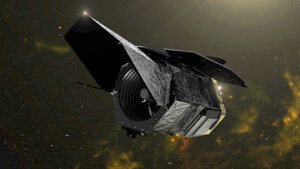
Space-based telescopes and survey satellites monitor NEOs.
Instruments detect size, composition, trajectory, and rotation.
Enables early warning for potential Earth impacts.
Characterization Missions
Spacecraft rendezvous with asteroids to study their structure and composition.
Instruments include spectrometers, cameras, and radar.
Provides critical data for potential deflection strategies.
Deflection Demonstrations
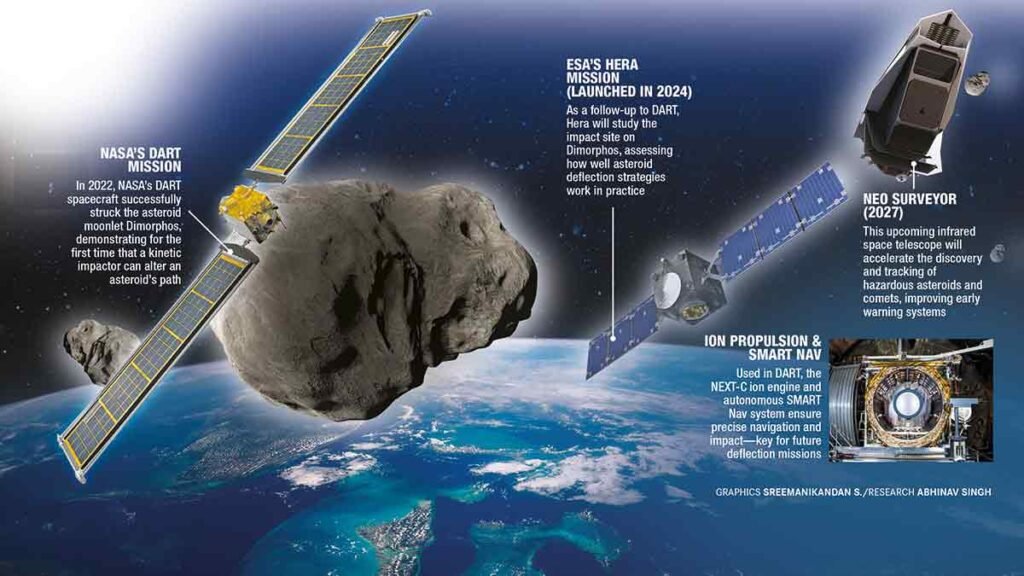
Kinetic impactor missions to test asteroid trajectory alteration.
Evaluates effectiveness of nudging asteroids away from Earth.
Includes autonomous navigation and precision targeting.
Multi-Mission Networks
Combining ground-based observatories, orbiters, and flyby spacecraft.
Continuous monitoring of high-risk objects.
Data shared with international partners for global defense readiness.
AI and Autonomous Systems
Onboard AI guides spacecraft for precise asteroid rendezvous.
Autonomous analysis of asteroid surface and trajectory.
Enhances mission efficiency and reduces Earth-based control latency.
Scientific and Operational Goals
NASA’s planetary defense missions aim to:
Early Detection: Identify potentially hazardous asteroids years or decades in advance.
Trajectory Analysis: Calculate precise orbits to predict Earth encounters.
Mitigation Strategies: Test techniques for deflection or disruption.
Characterization of Asteroids: Understand composition, density, and structural integrity.
International Collaboration: Share data and coordinate planetary defense efforts globally.
These objectives combine science, engineering, and global safety in one comprehensive program.
Challenges of Planetary Defense Missions
Distance and Speed: Asteroids move quickly and may be far from Earth.
Unknown Composition: Some asteroids are loose “rubble piles,” making deflection challenging.
Precision Requirements: Trajectory alteration must be extremely accurate.
Communication Delays: Deep-space operations require autonomous control.
Funding and Coordination: International cooperation and sufficient resources are essential.
NASA addresses these challenges through advanced propulsion, AI navigation, robust spacecraft design, and global partnerships.
Impact of Planetary Defense Missions
Global Safety: Reduces risk of catastrophic asteroid impacts.
Scientific Discovery: Provides insights into asteroid formation and solar system evolution.
Technological Innovation: Advances spacecraft navigation, instrumentation, and autonomous systems.
International Collaboration: Encourages joint research and shared defense strategies.
Public Awareness: Demonstrates proactive measures to protect humanity from space hazards.
Planetary defense is not just precautionary — it drives innovation and exploration while safeguarding Earth.
Future Prospects Beyond 2026
NASA envisions:
Expanded space-based asteroid monitoring networks.
Multi-asteroid rendezvous and sample-return missions.
More sophisticated deflection methods, including gravity tractors and nuclear options.
Coordination with ESA, JAXA, and other space agencies for global planetary defense.
Integration with AI-powered autonomous systems for real-time threat mitigation.
By the 2030s, planetary defense may become a routine part of space exploration infrastructure, ensuring Earth’s long-term safety.
Conclusion
NASA’s planetary defense asteroid missions 2026 represent a critical intersection of science, technology, and global safety. By detecting, tracking, and developing mitigation strategies for potentially hazardous asteroids, these missions protect Earth while advancing our understanding of small bodies in the solar system.
Through cutting-edge spacecraft, autonomous systems, and international collaboration, NASA is preparing to meet one of the most significant challenges humanity could
face — ensuring that asteroid impacts remain a manageable threat rather than a catastrophic event. ☄️🛡️