
Science is often thought of as something that happens in high-tech labs with expensive equipment. However, the truth is that anyone can explore the wonders of science from their own home, school, or backyard through DIY (Do-It-Yourself) experiments. DIY experiments are not only fun, but they also teach critical thinking, problem-solving, and creativity. They can inspire curiosity in young minds and give teenagers and adults alike the satisfaction of discovering principles through hands-on experience.
In this article, we will explore what DIY experiments are, why they are important, the types of experiments you can try at home, safety tips, and a few simple experiments you can start today.
What Are DIY Experiments?
DIY experiments are scientific experiments that individuals conduct on their own without the need for professional laboratories. These experiments use common household items or easily obtainable materials to explore basic scientific principles. From chemical reactions to physics demonstrations, DIY experiments make learning interactive and memorable.
Unlike traditional classroom experiments, DIY experiments allow you to control the pace, choose your materials, and even modify procedures to test different hypotheses. This flexibility encourages creativity and independent thinking, which are essential skills in science and problem-solving.
Why DIY Experiments Are Important
DIY experiments are more than just fun activities; they have several educational and personal benefits:
- Hands-On Learning: Research shows that students learn better when they engage in active, hands-on learning. DIY experiments allow learners to observe phenomena directly rather than just reading about them in textbooks.
- Critical Thinking Skills: Conducting experiments involves forming hypotheses, testing ideas, observing results, and analyzing outcomes. These steps develop logical reasoning and scientific thinking.
- Encourages Curiosity: Science begins with asking questions. DIY experiments nurture curiosity by prompting questions like “What happens if I mix these two substances?” or “Why does this reaction produce bubbles?”
- Cost-Effective Learning: Many DIY experiments require minimal investment because they rely on everyday items such as vinegar, baking soda, food coloring, or plastic bottles.
- Family and Peer Engagement: DIY experiments can be group activities, promoting teamwork and communication skills. They are perfect for classrooms, science clubs, or family bonding.
Types of DIY Experiments You Can Try
DIY experiments can be categorized into several types depending on the branch of science they explore. Here are the most popular categories:
1. Chemistry Experiments
Chemistry experiments are among the most exciting DIY activities because they often produce visible reactions such as color changes, fizzing, or bubbling. Examples include:
- Baking Soda and Vinegar Volcano: A classic experiment where the acid-base reaction creates an erupting “lava” effect.
- Color Changing Milk: Using food coloring and dish soap to explore surface tension and chemical reactions.
- Homemade Slime: Combining glue, baking soda, and contact lens solution creates a polymer that can stretch and bounce.
2. Physics Experiments
Physics DIY experiments demonstrate concepts like motion, gravity, energy, and magnetism. Examples include:
- Balloon Rocket: Using a balloon, straw, and string to show Newton’s third law of motion.
- Pendulum Experiments: Measuring how length affects swing speed to understand periodic motion.
- DIY Electromagnet: Wrapping wire around a nail and connecting it to a battery to explore magnetism.
3. Biology Experiments
Biology experiments often focus on plants, animals, or microorganisms. They can teach about life cycles, genetics, or ecosystems. Examples include:
- Seed Germination: Observing how seeds sprout under different conditions like light or water.
- Mold Growth Experiments: Using bread or fruit to study fungal growth patterns (done safely with supervision).
- Leaf Chromatography: Extracting pigments from leaves to understand photosynthesis and pigment composition.
4. Environmental Science Experiments
Environmental experiments can raise awareness about pollution, recycling, and sustainability. Examples include:
- Water Filtration Experiment: Building a simple filter using sand, gravel, and cotton to understand water purification.
- DIY Composting: Observing how organic waste decomposes over time and produces nutrient-rich soil.
- Oil Spill Cleanup: Simulating an oil spill using water and cooking oil to test different cleanup methods.
Safety Tips for DIY Experiments
Even though DIY experiments are done at home, safety should always be the top priority. Here are some essential safety tips:
- Wear Protective Gear: Use gloves, goggles, and aprons to protect your skin and eyes, especially during chemical reactions.
- Work in a Well-Ventilated Area: Some reactions release gases that should not be inhaled. Always open a window or perform experiments outside.
- Read Instructions Carefully: Follow experiment steps precisely to avoid accidents or unwanted reactions.
- Avoid Dangerous Chemicals: Stick to household items or recommended DIY kits. Avoid strong acids, flammable liquids, or toxic substances.
- Supervision for Teens and Kids: Younger experimenters should always have adult supervision to prevent accidents.
Easy DIY Experiments You Can Start Today
Here are three simple DIY experiments that you can try immediately with household items:
1. Rainbow in a Glass
Materials: Water, sugar, food coloring, and a clear glass.
Procedure:
- Mix different amounts of sugar in separate cups of water (e.g., 1 tbsp, 2 tbsp, 3 tbsp).
- Add a different color to each cup.
- Slowly pour each colored solution into the glass starting with the most sugary solution.
- Observe how the liquids form separate layers creating a rainbow effect.
Scientific Principle: Density differences between liquids prevent them from mixing quickly.
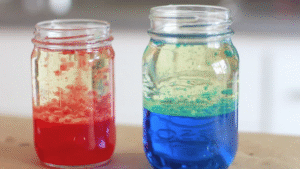
2. Homemade Lava Lamp
Materials: Clear bottle, water, vegetable oil, food coloring, and an effervescent tablet (like Alka-Seltzer).
Procedure:
- Fill the bottle halfway with oil and the other half with water.
- Add a few drops of food coloring.
- Break the tablet into pieces and drop them in.
- Watch as bubbles rise and fall, creating a lava lamp effect.
Scientific Principle: Oil and water don’t mix, and the gas from the tablet creates movement.
3. Static Electricity Butterfly
Materials: Tissue paper, a balloon, and a small piece of cardboard.
Procedure:
- Cut a butterfly from tissue paper and place it on the cardboard.
- Rub a balloon on your hair or a wool sweater to generate static electricity.
- Bring the balloon close to the butterfly without touching it.
- Watch the butterfly wings lift.
Scientific Principle: Static electricity causes the tissue paper to be attracted to the balloon.
Conclusion
DIY experiments are an amazing way to explore science, stimulate creativity, and have fun at the same time. They make abstract concepts tangible, teach critical thinking, and develop problem-solving skills. From chemistry and physics to biology and environmental science, the possibilities are endless. By following safety guidelines and using everyday materials, anyone can turn their home into a mini laboratory.
Whether you are a student wanting to impress in class, a parent looking to engage your child in educational play, or a curious teen exploring the wonders of science, DIY experiments are a gateway to discovery. So grab some household items, pick an experiment, and let your curiosity lead the way—science is waiting for you to explore it, one experiment at a time.