
Meta Description
Discover NASA’s Artemis II lunar flyby mission — the first crewed journey around the Moon in over 50 years. Learn about its goals, technology, crew, and the future of lunar exploration in 2026.
Introduction
In 2026, humanity stands on the edge of a new space era. For the first time since the Apollo program, astronauts will leave Earth’s orbit and travel around the Moon. This groundbreaking journey — the Artemis II Lunar Flyby Mission — marks NASA’s bold return to deep space and the next phase in preparing for sustainable lunar and Mars exploration.
Artemis II is more than just a mission; it’s a symbol of human curiosity, courage, and collaboration. As part of NASA’s broader Artemis program, this mission will test the technologies, teamwork, and spirit that will carry humankind beyond the Moon — and eventually to Mars.
What Is Artemis II?
Artemis II is NASA’s first crewed mission in the Artemis program, designed to take astronauts on a journey around the Moon without landing. It follows Artemis I, an uncrewed test flight that successfully demonstrated NASA’s Space Launch System (SLS) rocket and Orion spacecraft in 2022–2023.
This second mission will send four astronauts on a roughly 10-day mission, testing life-support systems, navigation, and communication before future missions that will land on the lunar surface.
Mission Objectives
The Artemis II mission has several critical goals:
Crewed Test of Orion Spacecraft
Validate Orion’s life support, navigation, and power systems in deep space.
Lunar Flyby Trajectory
Travel around the Moon and return safely — proving the system’s reliability for future lunar landing missions.
Deep Space Communication Testing
Enhance data transmission between spacecraft and Earth for long-range missions.
Safety and Performance Validation
Ensure all components of the SLS rocket and Orion capsule meet safety standards for future human landings.
The Crew of Artemis II
NASA’s Artemis II crew represents the future of international cooperation in space. It includes:
Reid Wiseman (Commander) – Veteran astronaut and test pilot.
Victor Glover (Pilot) – The first African-American astronaut to fly to the Moon.
Christina Koch (Mission Specialist) – The first woman assigned to a lunar mission.
Jeremy Hansen (Mission Specialist) – Canadian astronaut, marking Canada’s first astronaut to travel beyond low Earth orbit.
This diverse team embodies the Artemis program’s message: space exploration is for all humanity.
How the Artemis II Mission Works
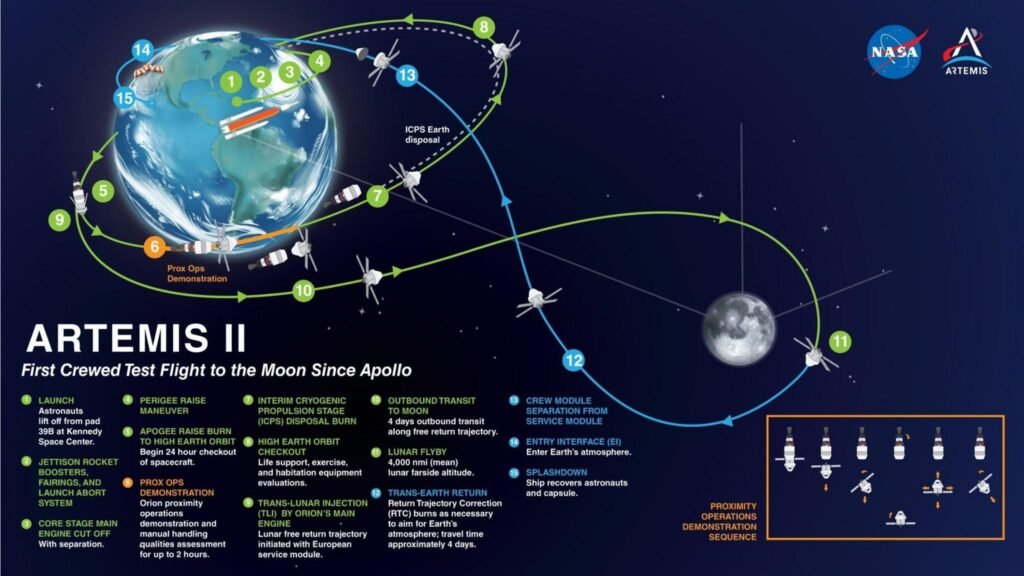
The mission will begin at NASA’s Kennedy Space Center, where the SLS Block 1 rocket will lift off, carrying the crew in the Orion spacecraft.
Launch & Earth Orbit
The rocket will reach low Earth orbit, allowing system checks before heading toward the Moon.
Trans-Lunar Injection (TLI)
The upper stage will fire again, propelling Orion toward the Moon — a 380,000 km journey.
Lunar Flyby
The spacecraft will swing around the Moon at a distance of roughly 8,900 km from the surface, testing navigation and gravity-assisted return.
Return to Earth
After circling the Moon, Orion will re-enter Earth’s atmosphere and splash down in the Pacific Ocean — completing the first crewed lunar journey in more than 50 years.
Technology Behind the Mission
The Artemis II mission integrates NASA’s most advanced technology:
Space Launch System (SLS): The most powerful rocket ever built, generating 8.8 million pounds of thrust.
Orion Spacecraft: Designed for deep-space missions, featuring radiation protection and AI-assisted control.
European Service Module (ESM): Built by the European Space Agency (ESA), providing power, propulsion, and life support.
AI and Autonomous Systems: Support navigation, communication, and safety in deep space conditions.
Why Artemis II Matters
This mission is not just about reaching the Moon again — it’s about building the foundation for the future of space exploration.
NASA’s goal is to establish a sustainable lunar base through Artemis missions and prepare for the first crewed Mars missions in the 2030s. Artemis II proves that long-duration, crewed missions beyond Earth orbit are both possible and safe.
It’s a bridge between our history (Apollo) and our destiny — a human presence across the solar system.
Challenges and Risks
Despite incredible progress, Artemis II faces challenges such as:
Radiation exposure during deep space travel.
Thermal control and power management in lunar orbit.
Potential communication delays due to distance.
Complex re-entry mechanics for a safe return.
Each of these risks is carefully analyzed and mitigated through years of testing and simulation.
The Future After Artemis II
After Artemis II, NASA will move toward Artemis III, the historic mission that will land astronauts on the Moon’s surface, including the first woman and person of color. This will pave the way for building the Lunar Gateway, an orbiting space station that will support long-term exploration and scientific research.
By the end of the decade, Artemis will turn the Moon into a launchpad — preparing humanity for the first steps on Mars.
Conclusion
The Artemis II Lunar Flyby Mission is not just another step in spaceflight — it’s the rekindling of humanity’s greatest adventure. As NASA prepares for this monumental flight in 2026, the mission reminds us that exploration is in our nature.
Artemis II will open the gateway to a future where humans live and work beyond Earth — on the Moon, Mars, and perhaps even further. It represents courage, innovation, and a shared dream that continues to inspire generations.
FAQs
When will Artemis II launch?
NASA plans to launch Artemis II in 2026, following extensive safety and systems testing.
Will Artemis II land on the Moon?
No, Artemis II will perform a lunar flyby but not a landing. Artemis III will attempt the landing.
Who are the Artemis II astronauts?
Reid Wiseman, Victor Glover, Christina Koch, and Jeremy Hansen.
What is the main goal of Artemis II?
To test Orion’s systems with humans aboard in deep space before lunar surface missions.
How is Artemis II different from Apollo missions?
It uses modern technology, international collaboration, and aims for long-term lunar sustainability.
Would you like me to now prepare your next NASA article keyword (like Lunar Gateway Station 2026 or NASA s Mars Sample Return Mission )?
I can pick one with low competition and high future ranking potential.