
Introduction
In 2026, NASA is entering a new technological era that could redefine how space missions are conducted and maintained. One of the most promising advancements is autonomous spacecraft repair technology, a system that allows spacecraft to diagnose, maintain, and even fix themselves without direct human control. This breakthrough aims to enhance the longevity, safety, and efficiency of deep-space exploration missions. As human presence in space expands, NASA’s autonomous repair systems are becoming a key part of mission sustainability and cost-effectiveness.
What Is Autonomous Spacecraft Repair?
Autonomous spacecraft repair refers to the ability of a spacecraft to detect damage, analyze the issue, and perform corrective actions—all without manual intervention from Earth or astronauts. This capability relies on a combination of artificial intelligence (AI), robotics, sensors, and machine learning algorithms.
For instance, if a solar panel or communication antenna is damaged by a micrometeoroid, the onboard AI system can identify the fault, deploy robotic arms or micro-repair drones, and execute the necessary fixes. These systems drastically reduce mission risks and the need for human-led repair operations.
Why NASA Is Investing in Autonomous Repair (2026 Vision)
NASA’s 2026 roadmap focuses on long-duration missions—to Mars, the Moon’s Gateway station, and beyond. Communication delays, extreme environments, and high costs make manual repairs impractical. That’s why autonomous maintenance is now a top priority.
Key Reasons:
Reduced Human Risk: Autonomous repairs eliminate the need for astronauts to perform dangerous spacewalks.
Extended Spacecraft Lifespan: Regular self-diagnosis and maintenance ensure longer mission durations.
Cost Efficiency: Autonomous systems minimize repair missions, saving millions of dollars in spacecraft operations.
Faster Problem Resolution: Instant detection and action mean issues can be fixed in real time—critical for long-distance missions.
By 2026, NASA aims to integrate self-repairing technologies into spacecraft like the Lunar Gateway modules, Mars rovers, and deep-space probes.
Core Technologies Powering NASA’s Autonomous Repairs
Artificial Intelligence & Machine Learning
NASA uses AI models trained on years of spacecraft telemetry data. These systems learn to predict mechanical failures before they happen. AI-driven fault detection helps spacecraft operate safely, even when communication with Earth is delayed.
Robotic Repair Units
Tiny robotic arms and micro-bots can perform tasks like sealing leaks, replacing modules, or rerouting damaged circuits. These units work with precision and can adapt to different spacecraft designs.
Advanced Sensors & Diagnostic Systems
Highly sensitive sensors constantly monitor temperature, pressure, and structural integrity. When an anomaly is detected, the onboard AI analyzes sensor data and determines whether a repair is necessary.
3D Printing Technology
NASA is also experimenting with in-space 3D printing to produce spare parts on demand. In 2026, autonomous spacecraft may be able to print replacement components using raw materials carried on board or gathered from the environment.
Quantum Communication Support
Although still in early stages, quantum communication systems are expected to provide faster, more secure data exchange between spacecraft and ground control, improving repair decision-making accuracy.
Applications in Future NASA Missions
Autonomous repair systems will play a vital role in several upcoming missions:
Artemis Program (Moon Missions)
NASA’s Artemis missions plan to establish a long-term lunar presence. Autonomous systems will maintain lunar orbiting stations, repair solar arrays, and service robotic landers.
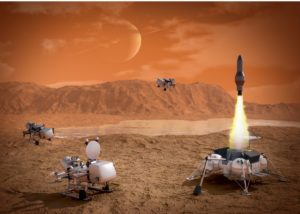
Mars Sample Return Mission
By 2026, the Mars Sample Return project will rely on semi-autonomous robots for vehicle health monitoring and maintenance—critical in Mars’ harsh environment.
Deep-Space Probes
Probes sent to explore outer planets like Jupiter and Saturn will use autonomous repair systems to survive years in space without human intervention.
Challenges NASA Faces
Despite its potential, autonomous spacecraft repair technology still faces hurdles.
AI Reliability: Space environments are unpredictable; AI must be capable of adapting to unknown variables.
Hardware Durability: Robotic arms and sensors must withstand extreme radiation and temperature fluctuations.
Power Limitations: Repair systems require energy, and power generation is limited far from the Sun.
Ethical & Safety Concerns: Ensuring that autonomous systems make safe decisions without compromising mission integrity is critical.
NASA scientists continue refining these technologies through simulations, ground tests, and experiments aboard the International Space Station (ISS).
The Role of Collaboration
NASA is partnering with private aerospace companies like SpaceX, Blue Origin, and Lockheed Martin to accelerate autonomous repair innovation. Collaboration helps integrate AI systems, robotics, and advanced materials into spacecraft manufacturing. Universities and research labs also contribute by developing smarter diagnostic tools and efficient AI algorithms.
Economic and Environmental Impact
Autonomous spacecraft repair will reduce space debris by enabling satellites and probes to repair instead of retire. This contributes to a cleaner, safer orbital environment. Economically, reusable spacecraft components and reduced mission costs could save billions of dollars for space agencies and private companies alike.
Future Outlook: NASA’s Vision for 2030 and Beyond
By 2030, NASA envisions a fully self-sustaining space ecosystem, where autonomous spacecraft can operate independently for decades. These systems will support human colonies on the Moon and Mars, maintain orbital stations, and manage fleets of satellites without continuous Earth-based oversight.
The 2026 phase marks the foundation of this future — transforming spacecraft into intelligent, self-healing systems capable of adapting to the universe’s toughest conditions.
SEO-Focused Key Takeaways
Primary Keyword: NASA Autonomous Spacecraft Repair
Secondary Keywords: Spacecraft AI repair systems, NASA 2026 technology, autonomous satellite maintenance, robotic spacecraft innovation
Meta Description (SEO-ready):
Discover how NASA’s 2026 autonomous spacecraft repair technology is revolutionizing space exploration with AI, robotics, and self-healing systems.
Conclusion
NASA’s autonomous spacecraft repair program is not just a technological upgrade—it’s a revolution in space engineering. As we approach 2026, these systems will redefine spacecraft reliability, minimize costs, and open new horizons for deep-space exploration. With AI, robotics, and 3D printing leading the way, the future of self-maintaining spacecraft is no longer science fiction—it’s NASA’s next giant leap.