
Introduction The Next Big Leap in Space Propulsion
As we move into 2026, NASA is rewriting the rules of space exploration with one powerful innovation — Cryogenic Propulsion Technology.
This isn’t just another upgrade to rockets; it’s a revolution in how spacecraft are fueled, launched, and sustained for deep-space missions.
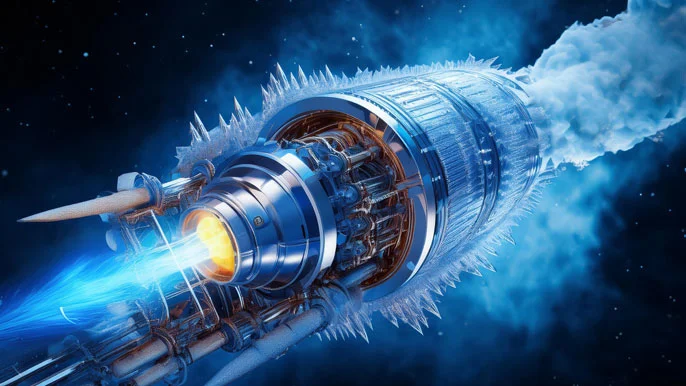
Cryogenic propulsion allows rockets to store and use super-cooled fuels, such as liquid hydrogen and liquid oxygen, giving them longer range, greater efficiency, and more thrust. NASA’s 2026 advancements in this technology could make human travel to the Moon, Mars, and beyond faster, cheaper, and more sustainable.
What Is Cryogenic Propulsion?
“Cryogenic” means extremely cold — and in rocket science, that means fuel stored at temperatures below -200°C.
NASA uses cryogenic fuels because they offer higher energy density than regular propellants. In simple words, you get more power from less fuel.
The two key fuels are:
Liquid Hydrogen (LH₂) – stored at -253°C
Liquid Oxygen (LOX) – stored at -183°C
When combined and ignited, they produce enormous thrust and clean exhaust — only water vapor!
But storing and handling these ultra-cold liquids in space isn’t easy. They evaporate quickly, and keeping them stable over long missions requires cutting-edge cooling, insulation, and pressure management systems — exactly what NASA’s 2026 cryogenic advancements are tackling.
Why NASA Is Investing in Cryogenic Propulsion (2026 Vision)
NASA’s long-term goal is sustainable deep-space travel.
Traditional propulsion systems can’t carry enough fuel for months-long missions to Mars or asteroids. Cryogenic propulsion solves that problem by offering high efficiency and refueling flexibility in orbit.
By 2026, NASA’s plan includes:
Developing reusable cryogenic stages for spacecraft.
Creating cryogenic refueling depots in Earth’s orbit.
Testing cryogenic engines for Artemis and Mars transport missions.
These innovations will cut mission costs, extend spacecraft range, and make human settlement on the Moon and Mars more realistic than ever.
Key Technologies Driving NASA’s Cryogenic Breakthroughs
Zero-Boil-Off Systems
One of the biggest challenges is fuel boil-off — cryogenic fuel gradually turning into gas and escaping.
NASA’s Zero-Boil-Off (ZBO) systems use electric cryocoolers and sun-shield insulation to maintain ultra-cold temperatures.
This keeps fuel stable for months instead of days, enabling long-term storage for deep-space missions.
Cryogenic Transfer Lines and Couplers
NASA is developing advanced transfer systems that allow spacecraft to refuel in space — just like gas stations in orbit.
These couplers are designed to work in zero gravity, maintaining perfect seals to prevent leaks or pressure loss.
Advanced Insulation Materials
Special multi-layer insulation blankets protect fuel tanks from solar heat.
These materials, inspired by spacecraft heat shields, minimize energy loss and improve tank performance.
Smart Pressure Control Systems
To prevent overpressure, NASA has built autonomous venting systems that balance temperature and fuel stability.
This system allows cryogenic engines to function smoothly even in extreme conditions.
Artemis and Cryogenic Propulsion: A Perfect Match
NASA’s Artemis Program, which aims to return humans to the Moon by 2026, heavily depends on cryogenic propulsion systems.
The Space Launch System (SLS) — NASA’s most powerful rocket — uses cryogenic hydrogen and oxygen to deliver unmatched thrust.
Future Artemis missions will test in-space cryogenic refueling, ensuring that spacecraft can travel between the Earth, Moon, and Mars without massive fuel payloads.
NASA’s Exploration Upper Stage (EUS), debuting in 2026, will feature improved cryogenic performance — allowing it to carry heavier payloads and travel farther than any previous rocket stage.
Cryogenic Propulsion and Mars Missions
When it comes to Mars, efficiency is everything.
NASA’s 2026 advancements will make Mars transfer vehicles more powerful and lighter by using cryogenic engines.
These vehicles could be refueled in orbit using stored cryogenic propellant depots, turning deep-space travel into a practical reality.
The Cryogenic Demonstration Mission, part of NASA’s technology roadmap, will validate in-space fuel transfer and storage — a key milestone toward Mars colonization.
Partnerships and Innovation
NASA isn’t working alone.
Private companies like SpaceX, Blue Origin, and Lockheed Martin are collaborating with NASA to develop cryogenic tanks, refueling systems, and engine upgrades.
Together, they’re pushing the limits of space propulsion to create a reusable, sustainable transportation network across the solar system.
This collaboration also fuels innovation in AI-driven monitoring, 3D printing of cryogenic parts, and advanced safety systems — all crucial for long missions.
Challenges Ahead
Even with all these advancements, cryogenic propulsion faces major hurdles:
Extreme Cooling Needs: Maintaining low temperatures in space is energy-intensive.
Material Durability: Metals contract and weaken at cryogenic temperatures.
Precision Handling: Fuel transfer in zero gravity demands perfect alignment and timing.
NASA’s engineers are testing new materials and automated systems to overcome these barriers before full deployment in 2026.
Environmental and Economic Benefits
Cryogenic propulsion isn’t just powerful — it’s clean.
Unlike traditional fuels, it produces zero carbon emissions, releasing only water vapor.
This makes it a greener choice for Earth launches and supports NASA’s goal of sustainable space exploration.
Economically, reusability and in-space refueling will cut mission costs by 40–60%, opening doors for more frequent and longer missions.
SEO Highlights for 2026 Search Ranking
Primary Keyword: NASA Cryogenic Propulsion Advancement
Secondary Keywords: cryogenic rocket fuel, NASA propulsion technology 2026, liquid hydrogen rocket, Artemis propulsion system
Meta Description:
Discover how NASA’s 2026 Cryogenic Propulsion Advancement is revolutionizing space travel with ultra-cold fuel, zero-boil-off storage, and in-space refueling systems.
Search Intent: Informational + Technological Innovation
Target Audience: Space enthusiasts, students, tech readers, and science news portals
Conclusion The Future Is Fueled by Cold Power
NASA’s Cryogenic Propulsion Advancement (2026) represents more than a technical milestone — it’s the key to unlocking the solar system.
By mastering ultra-cold fuels and in-space refueling, NASA is laying the foundation for a new space economy — one where human missions can reach Mars, asteroids, and even Jupiter’s moons.
In 2026, cryogenic propulsion isn’t just about rockets; it’s about rewriting the future of exploration — cleaner, faster, and bolder than ever before. 🌌