
Meta Description
Discover how NASA’s Deep Space Laser Communication technology is revolutionizing data transfer between Earth and distant spacecraft — delivering 100x faster speeds than radio waves and shaping the future of interplanetary internet by 2026.
Introduction
Imagine streaming high-definition video from Mars, transmitting gigabytes of scientific data from a distant asteroid, or even holding a live call with astronauts orbiting the Moon — all in real-time.
This futuristic vision is becoming possible thanks to NASA’s Deep Space Laser Communication systems.
By 2026, NASA is leading a new era of optical communication, replacing traditional radio systems with laser-based links that can transmit data hundreds of times faster, with greater precision and energy efficiency.
This isn’t just about speed — it’s about enabling humanity’s expansion deeper into the solar system. 🚀🌕🔴
What Is Deep Space Laser Communication?
Deep Space Laser Communication (DSOC) is NASA’s advanced method for transmitting information using light, rather than radio waves.
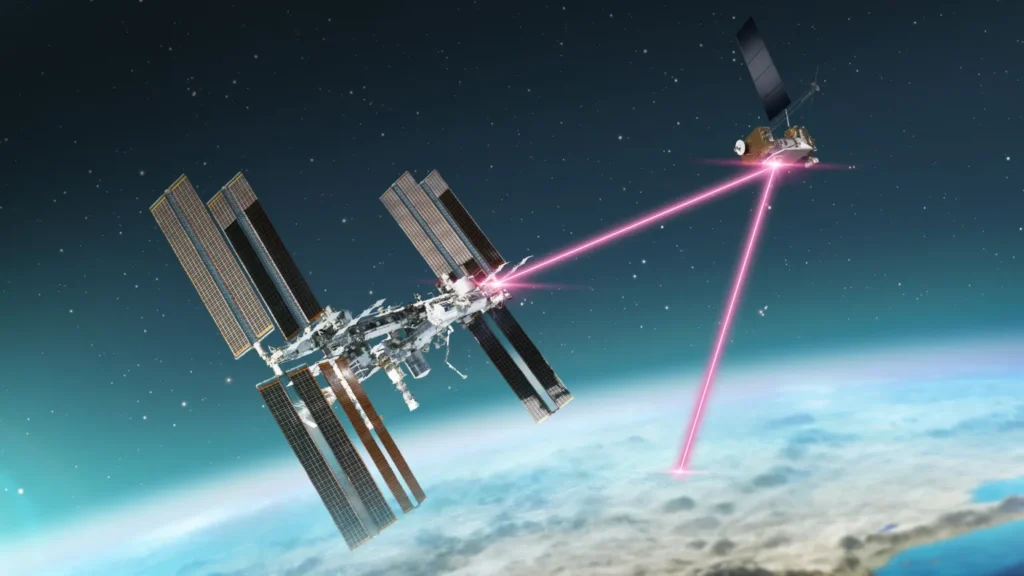
It uses highly focused infrared laser beams to send and receive data between spacecraft and ground stations.
🔭 How it works:
A laser transmitter converts digital data (images, videos, telemetry) into light signals.
These signals travel across millions of kilometers through space.
A receiver telescope on Earth or another spacecraft captures and decodes the light back into data.
The result: massive data transfers across interplanetary distances — at up to 100x the speed of traditional radio systems.
Why NASA Is Shifting from Radio to Laser
Since the 1950s, NASA has relied on radio communication, but it’s reaching its limits.
As spacecraft venture farther and send back more complex data — like 4K video or AI-processed images — radio bandwidth is becoming insufficient.
Laser systems solve this problem by offering:
Higher bandwidth: 10–100 times more data per second.
Smaller antennas: Compact, lightweight optical components.
Lower power use: More efficient energy-to-data ratio.
Greater security: Narrow laser beams are harder to intercept or jam.
This leap makes laser communication the backbone of future deep space missions — from the Moon to Mars and beyond.
How Deep Space Laser Communication Works (Step-by-Step)
Let’s break down the process:
Data Conversion: Digital data from a spacecraft’s instruments is encoded into laser light signals.
Transmission: A highly focused laser beam is aimed precisely at Earth or another spacecraft.
Propagation: The beam travels across millions of kilometers through vacuum space with minimal signal loss.
Reception: Large ground-based telescopes capture the faint light and convert it back into electronic data.
Processing: Computers decode, store, and analyze the incoming information for science and mission control.
💡 Fun Fact:
A laser beam from Mars takes about 8 to 20 minutes to reach Earth — depending on the planets’ positions — yet can transmit up to 1,000 times more data than radio in that same window.
NASA’s Key Laser Communication Projects (2026)
NASA has already conducted several pioneering experiments to test and perfect laser-based systems.
Here are the most important ones 👇
🌕Lunar Laser Communication Demonstration (LLCD)
🚀 Mission: NASA’s LADEE spacecraft (2013)
📍 Goal: Test high-rate laser communication from lunar orbit.
📡 Result: Achieved 622 Mbps downlink — a record-breaking speed.
This was NASA’s first successful space laser communication, proving the concept works.
🚀Laser Communications Relay Demonstration (LCRD)
📅 Launched: December 2021
🌍 Orbit: Geosynchronous Earth orbit
🎯 Goal: Serve as a test platform for two-way laser communication between ground and space.
LCRD allows NASA to experiment with real-time optical data relay, simulating future deep-space operations.
It’s a communication “hub” that helps refine tracking, weather interference management, and network reliability.
By 2026, LCRD’s findings will guide operational systems for lunar and Mars missions.
🪐Deep Space Optical Communications (DSOC)
📅 Tested on: NASA’s Psyche mission (launched October 2023)
🌌 Objective: Transmit data using lasers from beyond the Moon — all the way to the asteroid belt.
🔭 Technology: 1550-nanometer infrared laser with photon-counting detectors.
DSOC is NASA’s most ambitious demonstration yet — a crucial step toward interplanetary broadband communication.
It aims to prove that laser links can operate hundreds of millions of kilometers away, where signals are extremely faint and precise targeting is critical.
🛰️Artemis and Lunar Gateway Laser Systems
As part of the Artemis Program, NASA plans to establish optical terminals on the Lunar Gateway and lunar surface bases.
These systems will enable:
Fast data exchange between astronauts and mission control.
3D video transmission from lunar habitats.
Cloud-based data processing from orbit.
By 2026, Artemis missions will serve as the first human-crewed laser communication tests, forming the foundation of a lunar internet network. 🌕💫
The Advantages of Laser Communication in Deep Space
Laser communication offers a range of game-changing benefits over traditional radio waves:
✅ Ultra-high Data Rates – Transmit gigabytes per second, ideal for 4K video and large-scale science data.
✅ Reduced Latency – Shorter signal encoding and decoding times improve real-time coordination.
✅ Compact Systems – Smaller and lighter communication payloads save spacecraft weight.
✅ Power Efficiency – More bits per watt, crucial for long-duration missions.
✅ Increased Security – Focused laser beams are hard to detect or jam.
In essence, laser systems make space data transmission faster, safer, and smarter.
Challenges NASA Faces
Despite huge progress, deep-space laser communication presents major challenges:
Precision Targeting:
Lasers must be aimed with milliradian accuracy over millions of kilometers.
Atmospheric Distortion:
Earth’s atmosphere can scatter or absorb laser signals.
Alignment Issues:
Both spacecraft and Earth stations must maintain exact alignment while moving rapidly.
Limited Weather Windows:
Clouds, dust, or fog can interrupt optical links.
To overcome these, NASA is using adaptive optics, AI tracking algorithms, and global optical ground networks for redundancy.
The Future: The Interplanetary Internet (2030s and Beyond)
By 2030, NASA envisions a solar system-wide “Optical Internet” — a network of satellites, lunar bases, and Mars relays connected by laser links.
This network will:
Enable real-time data transfer between planets.
Support AI-driven mission control from Earth.
Allow live video communication between astronauts and scientists.
It’s the future of space connectivity — a web of light connecting worlds. 🌍🌕🔴
Impact on Earth and Science
NASA’s laser research isn’t just for space — it’s driving innovation here on Earth too.
🔬 Spinoffs include:
Quantum communication and encryption systems.
High-speed satellite internet.
Optical data links for remote sensing and defense.
These technologies are accelerating the global communication revolution, from fiber optics to space-based broadband networks.
Conclusion
NASA’s Deep Space Laser Communication is more than a technology — it’s a bridge to the stars.
By 2026, with projects like DSOC, LCRD, and Artemis optical links, NASA is building the foundation for high-speed interplanetary communication — unlocking faster data, clearer signals, and the ability to explore deeper than ever before.
As we look toward Mars and beyond, the message is clear:
The future of space communication is not radio — it’s light. 💡🚀
FAQs
What is NASA’s Deep Space Laser Communication?
It’s a high-speed data transmission system using laser light instead of radio waves.
How fast can laser communication transmit data?
Up to 100 times faster than traditional radio systems.
What is the Deep Space Optical Communications (DSOC) project?
A NASA demonstration on the Psyche mission testing long-distance laser links.
Why is laser communication important for Mars missions?
It allows real-time high-quality data transfer across vast distances.
What is the future goal of NASA’s laser communication technology?
To build an interplanetary internet connecting Earth, Moon, and Mars by 2030.