
Meta Description
Explore NASA’s Europa surface exploration plans, including upcoming missions, ice-penetrating technologies, and strategies to search for signs of life beneath the icy crust of Jupiter’s moon Europa.
Introduction
Europa, one of Jupiter’s largest moons, has captured the imagination of scientists and space enthusiasts for decades. Beneath its icy surface lies a global ocean that could harbor conditions suitable for life. NASA’s Europa surface exploration plans aim to investigate this mysterious world, combining advanced spacecraft instruments, ice-penetrating technologies, and orbital studies to uncover its secrets.
By 2026 and beyond, Europa could become the focal point of humanity’s search for extraterrestrial life within our solar system.
Why Europa Is Important
Europa is one of the most promising candidates for life beyond Earth because:
It has a thick ice shell covering a liquid water ocean.
The ocean may interact with a rocky mantle, providing chemical energy sources.
Tidal heating from Jupiter’s gravity keeps the subsurface ocean liquid and dynamic.
Studying Europa could reveal clues about habitability, ocean worlds, and the potential for life elsewhere in the solar system.
NASA’s Planned Missions to Europa
NASA has several missions and technologies in development to explore Europa:
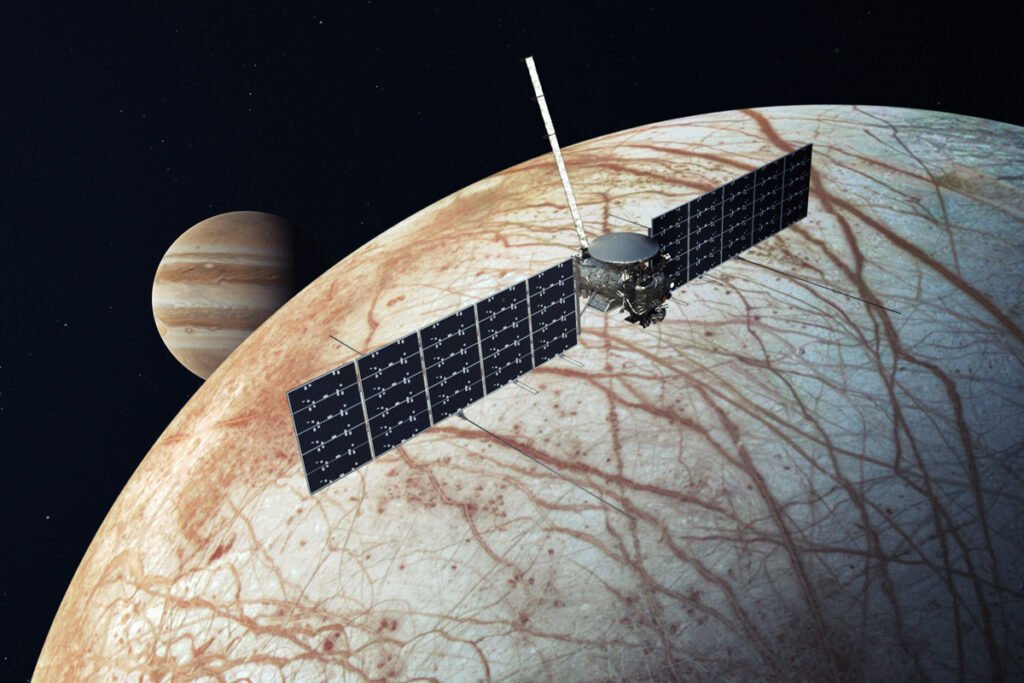
Europa Clipper Mission
Launch: Scheduled for the mid-2020s
Objective: Conduct detailed reconnaissance of Europa’s ice shell, surface composition, and subsurface ocean
Instruments: Ice-penetrating radar, thermal imaging, spectrometers, and magnetometers
Approach: Multiple flybys around Europa to gather high-resolution data without landing
Surface Lander Concepts
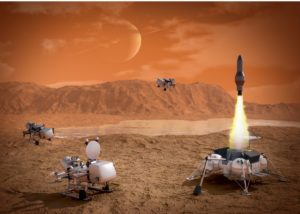
NASA is exploring future Europa lander missions to study the moon’s surface directly:
Instruments would analyze ice composition, search for organic molecules, and potentially detect microbial life
Challenges include extreme radiation from Jupiter and the thick ice shell
Ice-Penetrating Technologies
Advanced technologies are being developed to access Europa’s subsurface ocean:
Cryobots and melt probes: Robotic probes designed to melt or drill through the ice
Submersible probes: Miniature submarines capable of exploring the hidden ocean beneath Europa’s crust
These technologies will require precision engineering to withstand extreme cold, radiation, and communication delays.
Scientific Goals of Europa Exploration
NASA’s Europa surface exploration plans aim to answer critical questions:
Is Europa habitable?
Analyze ice and water composition for chemical energy sources and potential life-supporting conditions.
What is the ocean like?
Measure salinity, depth, temperature, and interactions with the rocky mantle.
How dynamic is Europa’s surface?
Study ice tectonics, ridges, and fractures to understand geological activity.
Are there signs of life?
Detect organic molecules, biosignatures, or microbial life in the ice or near surface ocean vents.
Technological Challenges
Exploring Europa is not easy. NASA faces several hurdles:
Radiation Hazard: Jupiter’s radiation belt can damage instruments and electronics
Thick Ice Crust: Ice may be tens of kilometers thick, making direct ocean access extremely challenging
Communication Delays: Signals take tens of minutes to travel between Earth and Europa
Autonomous Operations: Robots must operate independently due to long communication delays
NASA is addressing these challenges with radiation-hardened electronics, autonomous robotics, and advanced materials.
Impact of Europa Exploration
Exploring Europa will have profound scientific and societal impacts:
Search for Life: Discovering extraterrestrial life would be a historic milestone
Planetary Science: Europa could provide insights into ocean worlds, geology, and planetary evolution
Technology Development: Ice-penetrating probes and autonomous systems will advance space robotics
Public Inspiration: Europa missions will inspire generations to pursue science, space exploration, and innovation
Future Prospects Beyond 2026
NASA’s long-term vision for Europa includes:
Deploying landers and submersibles capable of reaching the subsurface ocean
Extended orbital missions for detailed mapping and monitoring of surface activity
Collaborative international missions to combine expertise and share data
By the 2030s, we may finally have the technology to directly sample Europa’s ocean, potentially discovering evidence of life beyond Earth.
Conclusion
NASA’s Europa surface exploration plans represent the next frontier in planetary exploration. By combining orbital reconnaissance, ice-penetrating technology, and future landers, humanity may soon uncover the secrets hidden beneath Europa’s icy crust.
The mission to Europa is not just a scientific endeavor — it is a quest to answer one of humanity’s most profound questions: Are we alone in the universe? 🌊🛸