
Meta Description
Explore NASA’s magnetosphere observation missions, studying Earth’s magnetic shield to understand space weather, protect satellites, and safeguard astronauts on future deep space missions.
Introduction
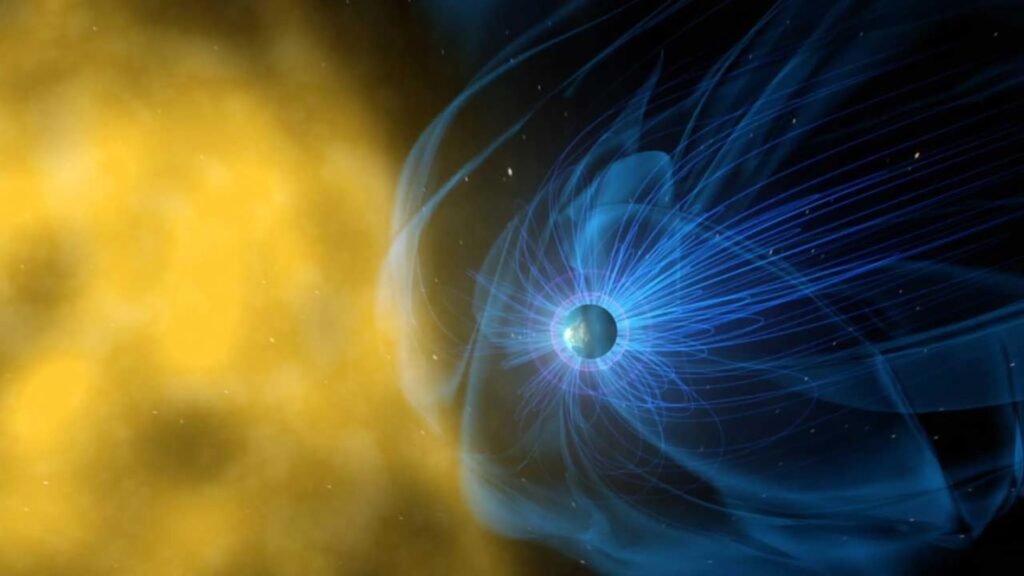
Earth’s magnetic field — the invisible shield surrounding our planet — protects us from dangerous solar winds and cosmic radiation. But despite its critical role, many aspects of the magnetosphere remain a mystery. NASA has launched several missions dedicated to studying this dynamic environment, known collectively as Magnetosphere Observation Missions.
These missions aim to understand how solar storms interact with Earth’s magnetic field, how radiation belts form and evolve, and how these phenomena impact both technology and human life.
What Is the Magnetosphere?
The magnetosphere is a region of space dominated by Earth’s magnetic field, stretching tens of thousands of kilometers into space. It acts as a shield against high-energy particles from the Sun, including:
Solar wind: A stream of charged particles constantly emitted by the Sun
Coronal Mass Ejections (CMEs): Intense bursts of solar plasma that can cause geomagnetic storms
Cosmic rays: High-energy particles from outside the solar system
Without this magnetic shield, life on Earth as we know it would be impossible — and satellites, astronauts, and even power grids would face serious risks.
Key NASA Magnetosphere Observation Missions
NASA has launched multiple missions to monitor and study the magnetosphere in detail. Some of the most notable include:
THEMIS (Time History of Events and Macroscale Interactions during Substorms)
Launched in 2007
Consists of five spacecraft studying the triggers and dynamics of magnetospheric substorms
Helps scientists understand how energy from the solar wind is stored and released in the magnetosphere, creating auroras
MMS (Magnetospheric Multiscale Mission)
Launched in 2015
Uses four identical spacecraft flying in formation to study magnetic reconnection — a process where magnetic field lines break and reconnect, releasing massive amounts of energy
Provides insight into how space weather phenomena can accelerate particles and impact Earth
Van Allen Probes
Launched in 2012 (active until 2019)
Focused on Earth’s radiation belts, also known as the Van Allen belts
Helped scientists understand how charged particles are trapped and accelerated by Earth’s magnetic field
IMAGE (Imager for Magnetopause-to-Aurora Global Exploration)
Launched in 2000
Captured global images of Earth’s magnetosphere in ultraviolet and X-ray wavelengths
Enabled scientists to visualize dynamic processes like auroras and magnetospheric storms
How NASA Observes the Magnetosphere
NASA combines advanced spacecraft instruments, high-resolution imaging, and computational modeling to study the magnetosphere. These tools include:
Magnetometers: Measure the strength and direction of magnetic fields
Particle Detectors: Track electrons, protons, and ions from the Sun
Imagers and Cameras: Capture auroral and plasma phenomena
Data Analysis Models: Simulate space weather interactions and predict geomagnetic storm impacts
By combining these observations, NASA can monitor real-time changes in the magnetosphere and improve space weather forecasting.
Scientific Goals of Magnetosphere Missions
NASA’s magnetosphere observation missions aim to:
Understand Space Weather:
Improve predictions of geomagnetic storms that can disrupt satellites, GPS systems, and power grids.
Protect Astronauts:
Develop strategies to safeguard astronauts on the ISS and future Moon or Mars missions from harmful radiation.
Study Fundamental Physics:
Investigate processes like magnetic reconnection, particle acceleration, and auroral formation.
Support Satellite Operations:
Provide data to help engineers design satellites that can withstand the effects of solar and cosmic particles.
Impact on Technology and Society
Space weather events influenced by the magnetosphere can have significant real-world consequences:
Satellite Damage: Strong solar storms can disrupt communication, navigation, and weather satellites.
Power Grid Failures: Geomagnetic storms can induce currents in power lines, causing blackouts.
Aviation Risks: High-altitude flights near the poles may expose passengers and crew to increased radiation.
NASA’s magnetosphere missions provide essential information to mitigate these risks and maintain modern technological infrastructure.
Future Magnetosphere Research
NASA plans to continue expanding its magnetosphere research through upcoming missions and collaborations with international space agencies:
ESCAPE (Exploration of Space Climate and Aurora Phenomena): A conceptual mission aimed at studying the global effects of solar storms.
Advanced Modeling Projects: Using AI and supercomputers to simulate magnetospheric dynamics in real-time.
Collaboration with ESA and JAXA: Sharing data from missions like Cluster and Arase to improve global understanding of space weather.
These initiatives will help humanity predict, prepare for, and respond to solar and cosmic disturbances like never before.
Conclusion
NASA’s Magnetosphere Observation Missions provide critical insight into the invisible forces that protect our planet. By studying Earth’s magnetic field and its interaction with solar and cosmic radiation, NASA helps safeguard satellites, power grids, and astronauts.
As space exploration expands to the Moon, Mars, and beyond, understanding the magnetosphere will be essential for human safety and technological resilience. These missions are more than scientific endeavors — they are humanity’s shield in the vast, unpredictable environment of space. 🌌🛡️