
Meta Description
Discover NASA’s Solar Sail Propulsion Projects — a revolutionary, sunlight-powered spacecraft technology redefining deep space exploration and sustainable travel beyond Earth in 2026 and beyond.
Introduction
Imagine a spacecraft that sails through space not with fuel, but with sunlight.
This is not science fiction — it’s solar sail propulsion, and NASA is making it a reality.
In 2026, NASA is advancing several Solar Sail Propulsion Projects that could transform how we explore the cosmos. These innovative spacecraft use photon pressure from sunlight to propel themselves, eliminating the need for heavy fuel and costly resupply missions.
The result? A cleaner, lighter, and potentially infinite form of propulsion — powered purely by the Sun. 🌞
What Is Solar Sail Propulsion?
Solar sail propulsion works on a beautifully simple principle: light carries momentum.
When photons from the Sun strike a large, reflective surface (the sail), they push it forward — just like wind pushes a sailboat.
Unlike rockets that burn fuel for thrust, a solar sail continuously accelerates as long as sunlight hits it.
This makes it perfect for long-duration missions to deep space, asteroids, and even interstellar destinations.
Key features of solar sail propulsion include:
Fuel-free propulsion (no chemical engines required).
Long-term acceleration using photon pressure.
Lightweight materials such as aluminized Mylar or Kapton.
Scalability for large, autonomous spacecraft fleets.
Why NASA Is Investing in Solar Sails
Traditional propulsion systems have limitations — they’re heavy, expensive, and finite.
Once fuel runs out, a spacecraft’s mission ends.
NASA’s Solar Sail Propulsion Projects aim to solve this problem by creating limitless propulsion using free solar energy.
The technology could support missions that are:
Sustainable: No need for fuel resupply.
Cost-efficient: Lightweight and inexpensive to launch.
Long-range: Capable of reaching distant orbits and deep space.
Continuous: Constant acceleration without engine stops.
In short, solar sails promise to change space exploration forever — making interplanetary and even interstellar travel achievable within this century.
Key NASA Solar Sail Projects (2026)
NASA has been developing solar sail technology for over a decade. By 2026, several major missions are under way or planned for testing and demonstration.
Let’s explore the most exciting ones 👇
☀️Advanced Composite Solar Sail System (ACS3)
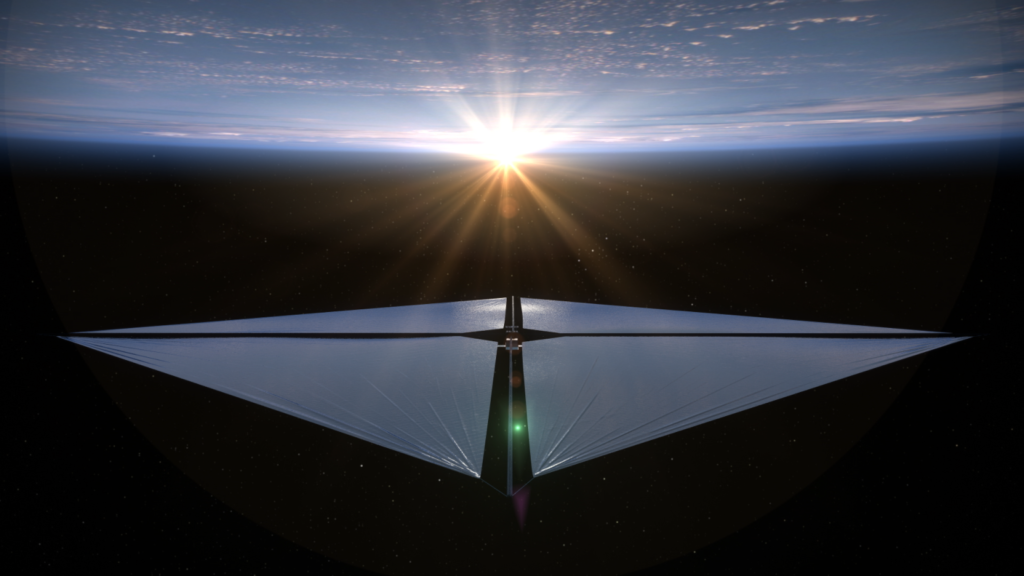
The ACS3 mission, led by NASA’s Small Spacecraft Technology Program, is one of the most promising solar sail experiments.
It aims to test new composite boom materials that can unfold a large, lightweight sail in space.
Launch year: 2026 (planned)
Mission type: Technology demonstration
Sail size: 80 square meters
Objective: Demonstrate efficient deployment and sunlight-powered propulsion
This mission will orbit Earth and gradually raise its altitude using only sunlight, proving that solar sails can maneuver without fuel.
🌕NEA Scout (Near-Earth Asteroid Scout)
Although launched earlier under Artemis I, NEA Scout continues to inspire 2026 developments.
It uses a 6U CubeSat equipped with a solar sail to visit a near-Earth asteroid.
By using sunlight as its only power source, NEA Scout demonstrates how miniaturized solar sails can support deep-space exploration at a fraction of the cost of traditional rockets.
🌌Solar Cruiser
NASA’s Solar Cruiser is one of the most ambitious solar sail projects ever conceived.
It will deploy an enormous sail — 17,800 square feet — to study how photon propulsion can maintain spacecraft in nontraditional orbits, such as hovering near the Sun-Earth Lagrange points.
Goals include:
Demonstrating precise solar sailing navigation.
Testing solar radiation pressure control.
Enabling new types of space weather monitoring missions.
Solar Cruiser is being developed by NASA Marshall Space Flight Center in partnership with Ball Aerospace, with a potential test flight window in the mid-2020s.
🚀Solar Sail Propulsion for Interstellar Probes
NASA’s long-term vision extends beyond the Solar System.
The Interstellar Probe Concept involves using giant solar sails to send small spacecraft beyond the heliosphere — the outer boundary of our Sun’s influence.
With continuous sunlight acceleration, such a probe could travel at unprecedented speeds, reaching the edge of interstellar space within decades.
This could give humanity its first direct data about the interstellar medium and pave the way for future missions to Alpha Centauri or other nearby stars.
How Solar Sails Work: The Science Behind the Magic
The physics of solar sailing combines elegance and innovation.
Here’s how it works step-by-step:
Deployment: Once in orbit, the spacecraft unfolds a large reflective sail — often the size of a tennis court.
Photon Pressure: Sunlight photons hit the sail’s surface and bounce off, transferring tiny amounts of momentum.
Continuous Acceleration: Over time, this small push accumulates, accelerating the spacecraft without using any fuel.
Directional Control: By tilting the sail, operators can steer the spacecraft — changing orbit, speed, or trajectory.
The longer it sails, the faster it goes — making solar propulsion ideal for deep-space travel.
Advantages of Solar Sail Technology
Solar sails offer several groundbreaking benefits for the future of exploration:
✅ Unlimited Propulsion: As long as sunlight exists, movement continues.
✅ No Fuel Dependency: Eliminates the biggest mass and cost constraint.
✅ Quiet and Clean: No exhaust, vibrations, or pollution.
✅ Ideal for Small Missions: Perfect for CubeSats and microsatellites.
✅ Interstellar Potential: Can travel beyond planets and moons.
Challenges NASA Must Overcome
Even though solar sails are revolutionary, there are challenges to solve:
⚙️ Deployment Reliability: Ensuring large sails unfold smoothly in space.
🌑 Material Durability: Sails must resist radiation and micrometeoroids.
📡 Navigation Accuracy: Managing precise attitude control using only photon pressure.
🔋 Power Generation: Combining solar propulsion with onboard electronics efficiently.
NASA’s engineers are testing next-generation reflective films, autonomous navigation software, and composite booms to address these issues by 2026.
The Role of AI and Automation in Solar Sail Missions
Artificial Intelligence is key to future solar sail navigation.
AI systems can:
Adjust sail angles for optimal sunlight exposure.
Predict and correct trajectory deviations.
Coordinate fleets of mini solar sail probes for data collection.
AI will make these spacecraft fully autonomous explorers, capable of operating millions of miles from Earth.
Future Possibilities: From Mars to Interstellar Space
By 2026 and beyond, NASA envisions solar sails as part of a new era of sustainable space travel:
Planetary observation missions around Mars and Venus.
Asteroid mapping using small CubeSat fleets.
Deep-space data relays beyond the outer planets.
Interstellar precursors that reach beyond the heliosphere.
In time, solar sails could become the preferred propulsion for long-duration missions, reducing costs and expanding our cosmic reach.
Conclusion
NASA’s Solar Sail Propulsion Projects are pushing humanity toward a future where sunlight powers exploration.
By 2026, missions like ACS3, Solar Cruiser, and Interstellar Probes will prove that we can travel vast distances using only light.
This technology represents the perfect blend of sustainability, innovation, and imagination — a testament to human ingenuity and our eternal drive to explore.
In the near future, every ray of sunlight might carry us closer to the stars. 🌠
FAQs
What is solar sail propulsion?
A spacecraft propulsion method that uses sunlight (photon pressure) instead of fuel for movement.
Does NASA currently use solar sails?
Yes. NASA has launched and is testing several solar sail missions like NEA Scout and ACS3.
How fast can solar sail spacecraft go?
They accelerate slowly but can eventually reach tens of kilometers per second over time.
Why is this technology important?
It enables sustainable, long-distance space travel without fuel, reducing cost and mass.
When will NASA’s major solar sail missions launch?
Several missions, including ACS3 and Solar Cruiser, are planned for 2026–2027.