
Meta Description
Discover how NASA’s cutting-edge space weather forecasting models predict solar storms, safeguard satellites, and protect astronauts on future missions to the Moon and Mars.
Introduction
Space is not silent or calm — it’s filled with invisible storms of energy and radiation unleashed by the Sun. These powerful events, known as space weather, can disrupt communication systems, damage satellites, and endanger astronauts. To counter these threats, NASA has developed some of the world’s most advanced space weather forecasting models.
In 2025 and beyond, these models will play a crucial role in protecting both Earth-based technology and future explorers venturing beyond our planet.
What Is Space Weather?
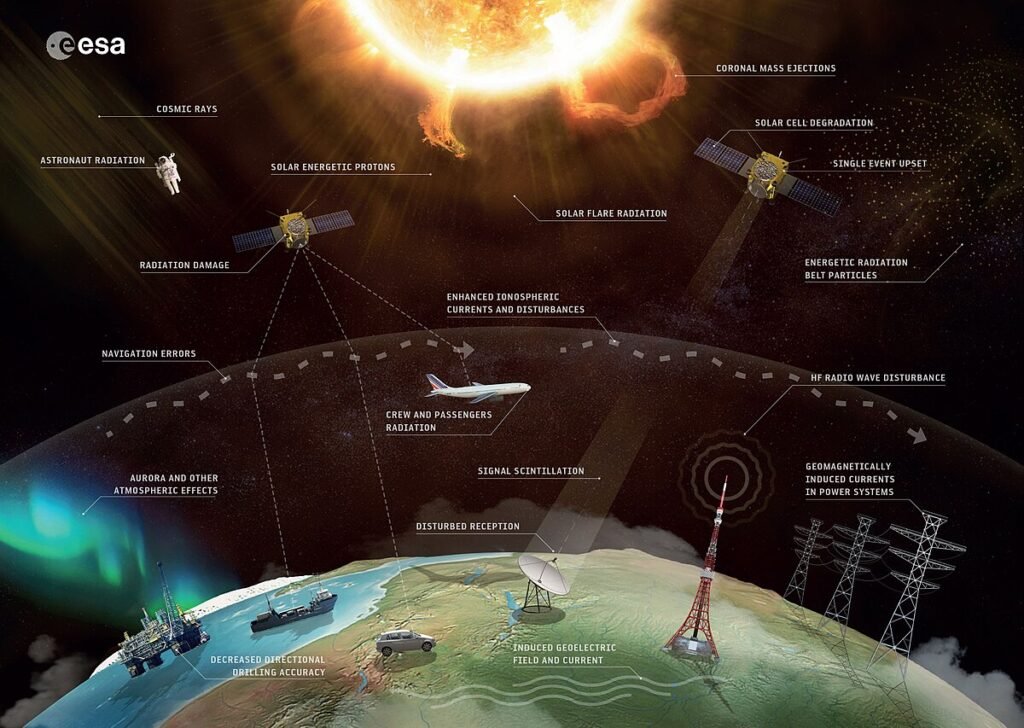
Space weather refers to conditions in space that are influenced by the Sun’s activity — such as solar flares, coronal mass ejections (CMEs), and high-energy particle storms.
When these solar outbursts reach Earth, they can cause:
GPS and radio signal disruption
Power grid failures
Increased radiation exposure for astronauts and airline crews
Satellite malfunctions
Accurate forecasting is therefore essential for modern civilization — and that’s exactly what NASA’s models are designed to do.
The Need for Forecasting Models
Just as meteorologists predict storms on Earth, NASA’s scientists forecast storms in space. But space weather prediction is far more complex.
Solar activity can vary dramatically, and disturbances travel millions of kilometers before reaching Earth. Predicting when and how these energetic particles will interact with Earth’s magnetic field requires sophisticated mathematical and physical models combined with real-time solar observations.
These models allow NASA to issue warnings hours or even days in advance, helping spacecraft operators and power companies take preventive measures.
NASA’s Space Weather Forecasting Systems
NASA uses a network of satellites, observatories, and data centers to power its space weather models. The most notable include:
ENLIL Model
Developed by NASA’s Goddard Space Flight Center, the ENLIL model is a 3-D magnetohydrodynamic (MHD) simulation that tracks the propagation of solar wind and coronal mass ejections (CMEs) from the Sun to Earth and beyond.
It predicts CME arrival times and potential impacts.
Operated in collaboration with NOAA’s Space Weather Prediction Center (SWPC).
Provides data for spacecraft safety and communication stability.
WSA–Enlil–Cone Model
This hybrid system combines the Wang-Sheeley-Arge (WSA) solar wind model with the ENLIL simulation, improving accuracy in predicting the speed and density of solar wind streams.
Widely used for operational space weather forecasting.
Helps determine when solar storms may disturb Earth’s magnetosphere.
CORHEL (Corona–Heliosphere) Model
The CORHEL model simulates the magnetic and plasma environment between the Sun and Earth. It integrates data from NASA’s Solar Dynamics Observatory (SDO) and Solar and Heliospheric Observatory (SOHO) to model how CMEs evolve as they travel through interplanetary space.
L1 Spacecraft Observations
Satellites positioned near the Lagrange Point 1 (L1) — including ACE, DSCOVR, and SOHO — provide real-time measurements of solar wind speed, density, and magnetic fields. These inputs feed NASA’s models to refine forecasts on the fly.
How NASA’s Models Work
NASA’s forecasting models rely on solar data assimilation — combining real-time observations with physics-based equations. Here’s how the process unfolds:
Observation: Solar telescopes and satellites record flares, CMEs, and sunspot activity.
Simulation: Models like ENLIL simulate how these events travel through the heliosphere.
Prediction: The models estimate when and how strong a storm will be when it reaches Earth.
Warning: NASA shares predictions with government agencies, airlines, and satellite operators to help them mitigate risks.
Artificial intelligence (AI) and machine learning are now being incorporated to improve predictive accuracy and shorten computation time.
Applications and Importance
NASA’s space weather forecasting models have real-world applications that affect millions of people every day:
Astronaut Safety: Radiation forecasting protects astronauts aboard the International Space Station and future Artemis missions to the Moon and Mars.
Satellite Operations: Predictive alerts allow engineers to power down sensitive systems during strong solar storms.
Communication Networks: NASA’s warnings help maintain GPS, internet, and radio communications during solar disturbances.
Power Grid Management: Utilities can temporarily reroute power loads to prevent transformer damage.
In short, space weather forecasting is essential for the reliability of global technology and future space travel.
Future Developments: AI and the 2030 Vision
Looking ahead, NASA plans to merge AI-driven predictive modeling with next-generation solar observatories. The upcoming IMAP (Interstellar Mapping and Acceleration Probe) mission will gather new data about the heliosphere, while AI will process that data in near-real time.
By 2030, NASA aims to develop an integrated forecasting network capable of predicting solar storms several days in advance — potentially transforming how we prepare for cosmic weather.
Challenges and Limitations
Despite incredible progress, challenges remain:
The complexity of solar dynamics means exact timing is hard to predict.
Limited observational coverage of the far side of the Sun leaves gaps.
Models require enormous computing power for real-time forecasting.
To overcome these barriers, NASA collaborates with international agencies and invests in supercomputing infrastructure to enhance model resolution and accuracy.
Conclusion
NASA’s Space Weather Forecasting Models represent humanity’s best defense against the unpredictable forces of our star. By combining data from solar observatories, AI algorithms, and magnetohydrodynamic simulations, NASA provides crucial warnings that protect satellites, astronauts, and entire power grids.
As technology advances toward 2026 and beyond, these models will evolve into a predictive shield — guarding our planet and ensuring that when the Sun storms, Earth remains safe beneath its scientific umbrella. ☀️🌍