
Meta Description
Explore NASA’s Voyager next phase missions in 2026, extending the legacy of Voyager 1 and 2 as they continue to study interstellar space and unlock the secrets beyond our solar system.
Introduction
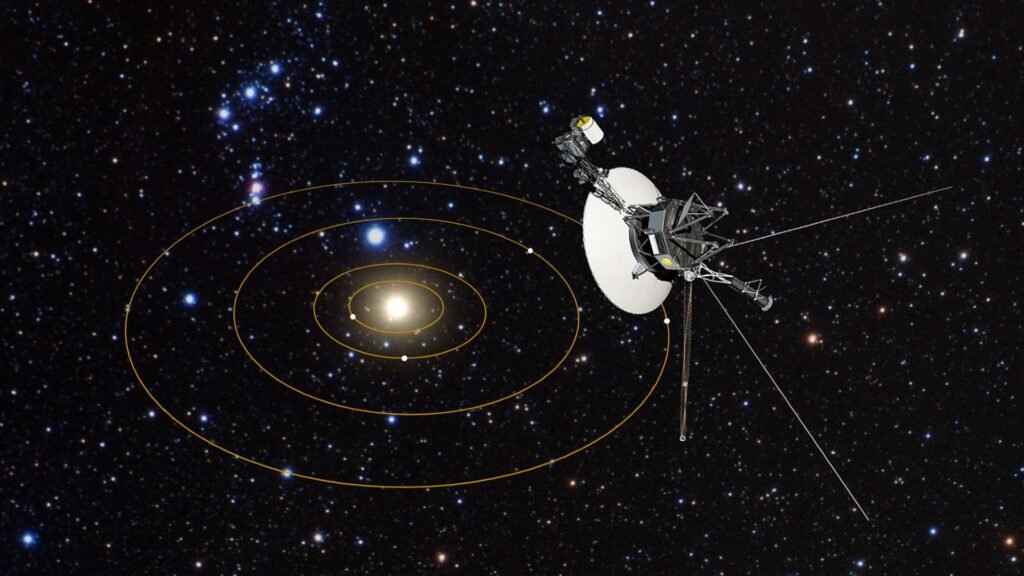
Since their launch in 1977, Voyager 1 and Voyager 2 have traveled farther than any human-made objects, crossing the heliopause and entering interstellar space. In 2026, NASA plans the next phase of Voyager missions, focusing on advanced data collection, interstellar exploration, and extending our understanding of the cosmos.
These missions aim to study cosmic rays, magnetic fields, and the interstellar medium, offering insights that could redefine humanity’s knowledge of the galaxy.
The Legacy of Voyager Missions
The Voyager spacecraft were initially designed to study the outer planets: Jupiter, Saturn, Uranus, and Neptune. Over the decades, they have:
Provided detailed images and measurements of planets, moons, and rings.
Sent back unprecedented data about the heliosphere — the bubble of charged particles surrounding our solar system.
Crossed into interstellar space, giving humanity its first direct glimpse beyond the Sun’s influence.
The Voyagers’ continuing success has laid the groundwork for future interstellar exploration.
NASA’s Next Phase in 2026
NASA’s 2026 plans focus on extending the operational life and scientific scope of the Voyager spacecraft:
Enhanced Data Transmission
Improving deep-space communication to continue sending high-value data from interstellar space.
Using updated ground stations and high-gain antennas to maximize signal reception.
Advanced Particle and Magnetic Field Studies
Continued measurement of cosmic rays, solar wind interactions, and magnetic fields in deep space.
Monitoring changes in the interstellar medium over time to understand the galactic environment.
Collaboration with Next-Generation Missions
Linking Voyager data with upcoming missions like Interstellar Probe or Heliophysics Explorer missions.
Combining datasets to study long-term solar and interstellar processes.
Scientific Goals of the Next Phase
The 2026 Voyager missions aim to:
Map Interstellar Space: Track density, composition, and behavior of interstellar plasma and magnetic fields.
Study Cosmic Rays: Monitor high-energy particles that could affect future space exploration.
Understand Heliosphere Boundaries: Examine how the solar wind interacts with interstellar material.
Legacy Data Continuity: Provide consistent long-term datasets for astrophysics and heliophysics research.
These goals help answer fundamental questions about the nature of space beyond our solar system.
Technological Challenges and Solutions
Operating spacecraft over 40 years old presents unique challenges:
Power Supply: Voyagers rely on radioisotope thermoelectric generators (RTGs), which decay over time. NASA is optimizing power allocation to essential instruments.
Communication Distance: The probes are over 20 billion kilometers away; data transmission is extremely slow. NASA uses deep-space networks and advanced coding to maximize efficiency.
Aging Hardware: Engineers are remotely managing old systems with creative software updates and careful resource planning.
Despite these obstacles, Voyager continues to deliver valuable insights.
Impact on Future Space Exploration
NASA’s Voyager next phase missions provide a foundation for:
Interstellar Travel Planning: Understanding particle environments and radiation hazards for future missions.
Long-Term Astrophysics Research: Continuous monitoring of cosmic phenomena beyond the heliosphere.
Public Engagement: Inspiring new generations about humanity’s reach into interstellar space.
The Voyagers are more than machines — they are a testament to human ingenuity and curiosity.
Conclusion
In 2026, NASA’s Voyager next phase missions will continue to expand our knowledge of the universe, sending humanity’s eyes farther than ever before. By studying the interstellar medium, cosmic rays, and magnetic fields beyond the solar system, Voyager 1 and 2 remain at the frontier of space exploration.
As these spacecraft journey into the unknown, they carry with them the enduring legacy of human curiosity — proving that even decades-old technology can continue to unlock the mysteries of the cosmos. 🌠