
Meta Description
Discover how NASA’s 2026 lunar dust mitigation technology is helping astronauts and spacecraft survive the harsh lunar environment by controlling the Moon’s most dangerous problem — dust.
Introduction
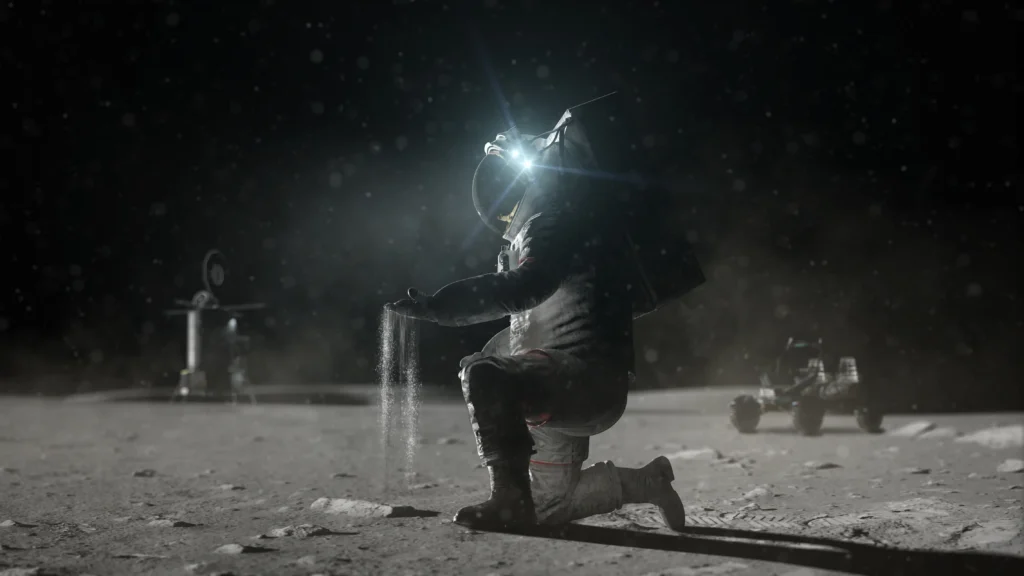
When humans return to the Moon under NASA’s Artemis Program, they will face an ancient but underestimated problem — lunar dust.
Unlike the soft dust we know on Earth, Moon dust is sharp, electrostatically charged, and incredibly sticky. It clings to everything — spacesuits, equipment, solar panels, and even inside spacecraft.
NASA calls it one of the biggest challenges for future lunar exploration. That’s why, in 2026, the agency is investing heavily in Lunar Dust Mitigation Technology — advanced systems designed to protect astronauts, vehicles, and habitats from the Moon’s microscopic menace.
What Is Lunar Dust and Why Is It a Problem?
Lunar dust, or regolith, is made of crushed rock, glass fragments, and metallic particles created by billions of years of meteor impacts.
Because there’s no atmosphere or wind on the Moon, dust grains are razor-sharp and stay suspended after every movement.
During the Apollo missions, astronauts discovered the problem firsthand — dust stuck to their suits, clogged seals, and even damaged instruments. Some astronauts experienced “lunar hay fever”, caused by breathing in fine dust particles.
Without dust protection, future lunar bases could suffer equipment failure, health risks, and reduced mission lifespan. NASA’s dust mitigation research aims to make the lunar surface safe for long-term human presence.
NASA’s 2026 Dust Mitigation Goals
NASA’s Lunar Dust Mitigation Technology program (LDMT) focuses on preventing dust from sticking, spreading, or damaging critical systems.
By 2026, NASA plans to deploy and test several new technologies on the Moon’s surface through the Artemis and CLPS (Commercial Lunar Payload Services) missions.
The program has three main objectives:
Protect Astronaut Health – Prevent inhalation and skin exposure.
Safeguard Spacecraft and Equipment – Stop dust from clogging joints, sensors, and solar panels.
Preserve Habitat Systems – Keep air filters, seals, and mechanical systems operational for months, not just days.
Key Dust Mitigation Technologies
NASA’s engineers and partners are developing innovative systems to battle lunar dust on multiple fronts.
Here are the most promising technologies for 2026 and beyond:
Electrodynamic Dust Shield (EDS)
The EDS system uses transparent electrodes embedded in surfaces like solar panels and visors. When activated, it generates an electrostatic field that shakes off dust particles.
This technology has been successfully tested on Earth and is now being adapted for the lunar environment.
Benefits:
Self-cleaning capability.
Works on solar panels, windows, and sensors.
Requires very little power.
Dust-Resistant Coatings and Fabrics
NASA is developing nanotechnology coatings that repel dust using chemical and physical properties.
Spacesuits, tools, and rover components coated with these materials will resist adhesion, keeping them cleaner for longer.
Benefits:
Protects astronaut suits and visors.
Reduces maintenance on rovers.
Increases the lifespan of mission hardware.
Magnetic Dust Control Systems
Because lunar dust contains iron particles, NASA researchers are experimenting with magnetic fields to capture or deflect dust.
This could help clean tools, airlocks, and mechanical joints automatically.
Benefits:
Non-contact cleaning method.
Useful for indoor airlocks and docking systems.
Works even in vacuum environments.
Regolith-Resistant Seals and Bearings
NASA’s mechanical engineers are redesigning seals and bearings to resist abrasion caused by dust infiltration.
These new components will help lunar rovers, landers, and habitats operate longer without mechanical wear.
Benefits:
Extends mission durability.
Reduces replacement and repair frequency.
Supports long-term lunar habitation.
Testing Dust Technologies on the Moon (2026)
NASA plans to test these technologies directly on the lunar surface in 2026 using robotic payloads and Artemis-related landers.
Key partners include:
NASA Glenn Research Center
NASA Kennedy Space Center
Commercial partners like Astrobotic and Intuitive Machines
Data from these tests will determine how well dust systems perform under real lunar gravity, temperature, and radiation conditions. Successful results will shape the hardware used in Artemis III and future lunar bases.
The Role of Artificial Intelligence and Automation
AI plays an increasing role in monitoring and controlling dust systems.
Smart sensors and machine learning models will:
Detect dust accumulation.
Activate cleaning systems automatically.
Predict high-dust conditions after landings or surface operations.
This automation will make lunar missions safer and more energy-efficient, reducing the need for manual maintenance.
Long-Term Vision: A Dust-Free Lunar Habitat
By 2026–2028, NASA envisions semi-permanent lunar habitats that can remain operational for months.
To achieve that, dust mitigation systems will be integrated into every layer — from the landing pad to the astronauts’ suits.
Future bases may feature:
Dust-repelling airlocks
Electrostatic floors that clean boots automatically
Self-cleaning solar arrays
AI-driven environmental monitors
These innovations will make the Moon not just visitable — but livable.
Why Lunar Dust Mitigation Matters
Without proper dust control, lunar missions could face:
Decreased solar efficiency (due to dust-covered panels)
Worn-out machinery and blocked joints
Damaged optics and sensors
Astronaut health hazards
In short, dust could end missions early.
With advanced mitigation technology, NASA can extend mission life, protect human health, and make lunar exploration sustainable.
Conclusion
NASA’s Lunar Dust Mitigation Technology program is more than just a cleaning system — it’s a lifeline for the future of space exploration.
In 2026, as the Artemis missions gear up for longer stays on the Moon, these technologies will ensure that astronauts can live and work safely on the lunar surface.
By solving the Moon’s oldest problem, NASA is paving the way for a new era of sustainable space colonization and bringing us one step closer to making the Moon humanity’s second home.
FAQs
Why is lunar dust dangerous?
Because it’s sharp, static, and easily sticks to everything, damaging equipment and harming human lungs.
What is NASA doing to control dust?
Developing electrostatic shields, magnetic filters, special coatings, and dust-resistant materials.
When will dust mitigation systems be tested?
In 2026, during Artemis and CLPS robotic missions.
Can this technology be used on Earth?
Yes — similar systems could help in deserts, solar farms, and clean-room environments.
How does this support future Moon bases?
It keeps habitats and machinery clean, safe, and efficient for long-term lunar living.