
Meta Description
NASA’s 2026 Lunar Surface Mobility Systems are transforming how astronauts travel, transport cargo, and explore the Moon — paving the way for permanent lunar bases and human sustainability.
Introduction
When humans return to the Moon under NASA’s Artemis Program, they won’t just visit — they’ll stay.
To live, work, and explore on the Moon, astronauts will need a reliable way to move across the rugged lunar terrain. That’s where NASA’s Lunar Surface Mobility Systems (LSMS) come in.
By 2026, NASA plans to deploy advanced rovers, cargo vehicles, and mobility platforms that can operate in extreme conditions — from scorching sunlight to freezing lunar nights. These machines will form the foundation of sustainable lunar exploration and open the door to a permanent human presence on the Moon.
What Are Lunar Surface Mobility Systems?
Lunar Surface Mobility Systems (LSMS) are a family of vehicles, rovers, and technologies designed to transport astronauts, equipment, and resources across the Moon’s surface.
These systems aren’t just simple rovers — they’re modular, autonomous, and highly adaptable to the Moon’s unpredictable landscape.
NASA’s vision includes:
Crewed lunar rovers for astronaut exploration.
Uncrewed cargo carriers for transporting supplies.
Flexible robotic platforms for scientific missions.
Mobile habitat systems for long-term lunar living.
Together, these technologies will help NASA build a sustainable lunar economy, where mobility means survival and success.
NASA’s Artemis Program and Mobility Goals
Under the Artemis Program, NASA is preparing for a long-term human return to the Moon by the late 2020s.
Mobility is central to this mission. Without it, astronauts would be limited to small exploration zones near their landing sites.
By 2026, NASA aims to:
Develop durable, energy-efficient lunar vehicles.
Enable day-and-night operations on the Moon’s surface.
Support construction and resource extraction missions.
Lay groundwork for Mars exploration systems using lunar lessons.
In short, mobility equals capability — and the more NASA can move on the Moon, the more science, building, and discovery can happen.
Key Components of NASA’s Lunar Mobility Systems
NASA’s LSMS program includes multiple technologies working together. Here are the key systems being developed and tested:
🧑🚀Lunar Terrain Vehicle (LTV)
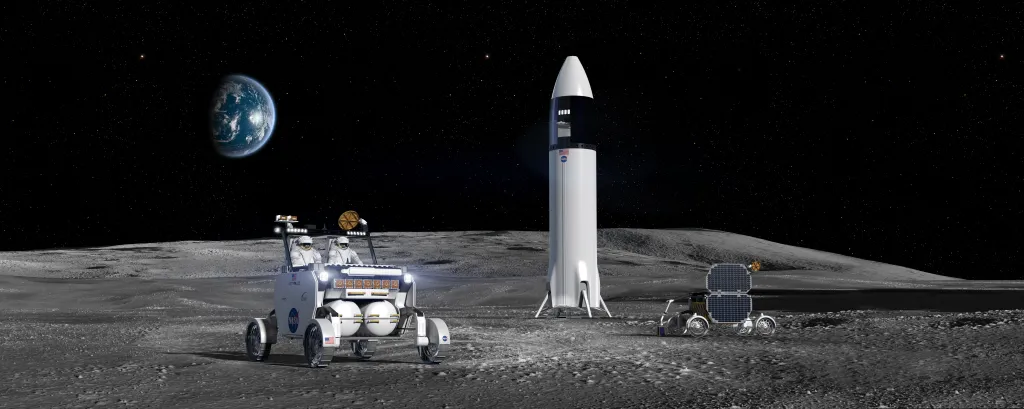
The Lunar Terrain Vehicle is NASA’s next-generation crew rover — an open-top, electric vehicle that will transport astronauts across several kilometers of lunar surface.
Built for two astronauts.
Equipped with autonomous driving and navigation.
Can operate manually or remotely.
Designed to handle extreme temperatures and dust.
NASA selected Intuitive Machines, Lockheed Martin, and GM Defense to develop prototypes for 2026 field tests.
🚚 Heavy Cargo Transporter (Lunar Utility Vehicle)
To build lunar bases, NASA needs machines that can move materials, solar panels, habitats, and mining tools.
The Lunar Utility Vehicle (LUV) is an autonomous cargo rover capable of carrying tons of equipment across the Moon’s surface.
Features include:
Modular loading decks.
Robotic arms for lifting and placement.
Self-charging solar systems.
Remote operation from lunar orbit or Earth.
These robotic workhorses will become the backbone of lunar logistics.
🧩 Modular Mobility Platform (MMP)
NASA’s Modular Mobility Platform is a flexible robotic chassis that can adapt to different missions.
It can function as a:
Cargo carrier.
Science rover.
Construction base.
Power distribution hub.
The platform can attach modular tools and payloads, allowing NASA to repurpose it for future needs — an efficient, sustainable design for long-term lunar infrastructure.
🌒 Pressurized Rover (Habitat on Wheels)
NASA is collaborating with JAXA (Japan Aerospace Exploration Agency) to design a pressurized rover — a mobile living habitat for long-duration exploration.
Can support 2 astronauts for up to 30 days.
Features life support, radiation protection, and sleeping quarters.
Capable of driving hundreds of kilometers without external power.
This rover will allow astronauts to live and explore far from their main base, turning the Moon into a truly accessible world.
The Challenges of Lunar Mobility
Operating vehicles on the Moon isn’t easy. NASA faces unique engineering challenges:
Extreme Temperatures:
From +120°C in sunlight to -180°C in darkness — batteries and electronics must endure both.
Lunar Dust:
Sharp, clingy dust particles can damage motors, joints, and seals.
Communication Delays:
Remote operation requires advanced AI for real-time decisions.
Energy Supply:
Vehicles must survive the two-week-long lunar night — when solar power isn’t available.
NASA’s engineers are testing solid-state batteries, advanced insulation, and nuclear micro-power systems to overcome these obstacles.
Power and Energy Innovations
To keep rovers active through harsh lunar nights, NASA is investing in several power solutions:
Solar Regolith Panels – Dust-resistant solar cells designed for low-angle sunlight.
Portable Nuclear Batteries – Compact reactors providing continuous energy for weeks.
Wireless Power Beaming – Transmitting energy between rovers and habitats without cables.
These power systems will ensure continuous exploration even when sunlight disappears for 14 days straight.
Role of AI and Automation
Artificial Intelligence plays a huge role in lunar mobility:
Autonomous Navigation: Rovers map and avoid hazards automatically.
Mission Coordination: AI distributes energy and tasks between multiple vehicles.
Predictive Maintenance: Sensors detect issues before breakdowns occur.
NASA’s rovers will essentially think for themselves, making lunar operations safer and more efficient.
Looking Ahead The Moon as a Transportation Hub
By the early 2030s, NASA’s vision is to create a lunar transportation network that supports:
Human bases at the lunar south pole.
Resource extraction for water, oxygen, and fuel.
Regular supply routes between habitats and landing zones.
Staging points for Mars missions.
Once mobility systems are fully operational, the Moon will no longer be just a destination — it will become a launch pad for humanity’s future in space.
Conclusion
NASA’s Lunar Surface Mobility Systems represent the next leap in human exploration.
By combining robotics, AI, and advanced engineering, these systems will enable astronauts to live, work, and travel across the Moon like never before.
In 2026 and beyond, lunar rovers won’t just explore the Moon — they’ll build its future.
Each wheel turn will take humanity one step closer to a sustainable space civilization and, eventually, to Mars and beyond.
FAQs
What are NASA’s Lunar Surface Mobility Systems?
They’re advanced vehicles and robotic platforms designed for transportation, exploration, and construction on the Moon.
When will NASA deploy them?
Initial testing begins in 2026 under the Artemis program.
What is the Lunar Terrain Vehicle (LTV)?
A crewed electric rover that allows astronauts to travel long distances on the lunar surface.
How will these systems be powered?
Through solar energy, portable nuclear power, and wireless power-sharing technologies.
Why is mobility so important for the Moon?
Without mobility, astronauts can’t explore, build habitats, or sustain long-term missions — mobility is the foundation of lunar living.