
Meta Description
Discover how NASA is developing magnetic shielding technology to protect astronauts from harmful cosmic radiation during deep space missions to Mars and beyond.
Introduction
Space — vast, beautiful, and dangerous. As humanity prepares for missions beyond Earth’s protective magnetic field, one of NASA’s biggest challenges is safeguarding astronauts from deadly cosmic radiation. Traditional materials like aluminum or polyethylene can only offer limited protection. To overcome this, NASA scientists are exploring a futuristic solution inspired by Earth itself — magnetic shielding.
What is Magnetic Shielding?
Magnetic shielding is the concept of using magnetic fields to deflect or redirect high-energy charged particles — the same way Earth’s magnetosphere shields us from cosmic rays and solar storms. Instead of relying on heavy physical barriers, a magnetic shield creates an invisible protective “bubble” around the spacecraft or habitat.
This approach not only reduces the weight of space vehicles but also offers potentially better protection against energetic particles that can penetrate even thick materials.
Why Astronauts Need Magnetic Protection
Beyond Earth’s orbit, radiation exposure becomes one of the most serious health threats to astronauts. There are two primary sources:
Solar Particle Events (SPEs): Powerful bursts of radiation from the Sun that can occur without warning.
Galactic Cosmic Rays (GCRs): High-energy particles originating outside our solar system, constantly bombarding space.
Prolonged exposure to these radiations can cause:
DNA damage and increased cancer risk
Nervous system degradation
Cardiovascular problems
Reduced cognitive function
Magnetic shielding could drastically reduce these risks — keeping astronauts safer during long-term missions to Mars or deep space.
NASA’s Research and Experiments
NASA has been experimenting with active radiation shielding for decades. One promising area involves using superconducting magnets to generate powerful magnetic fields.
Here are some key projects and breakthroughs:
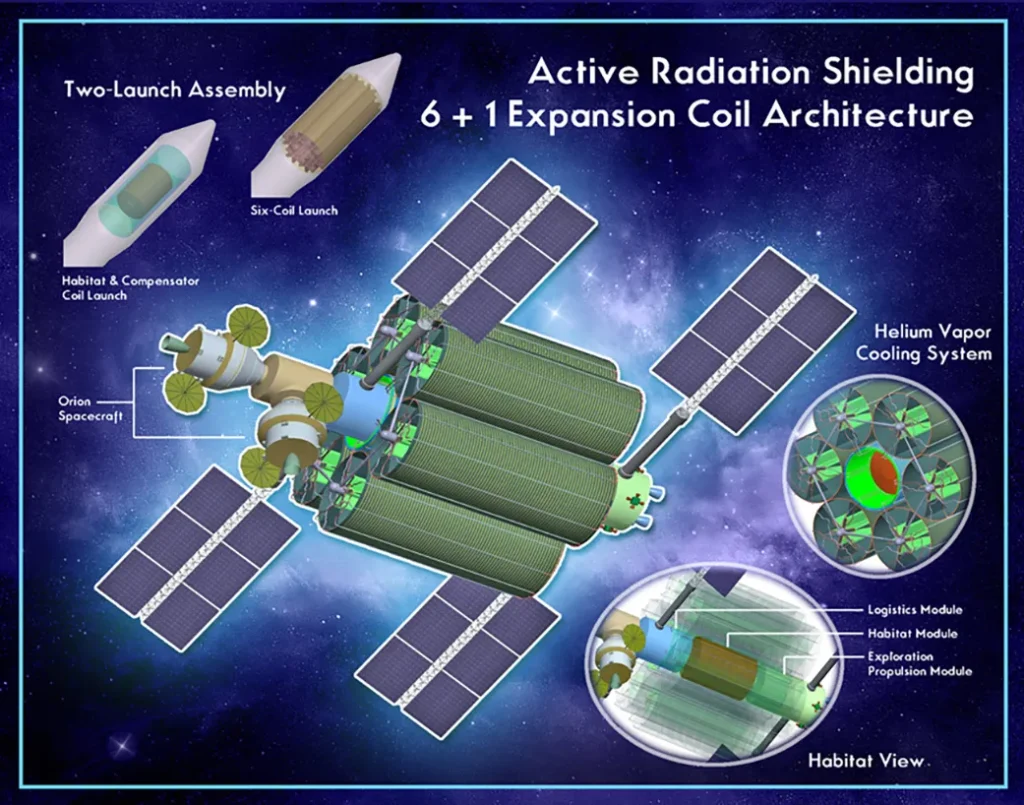
NASA Innovative Advanced Concepts (NIAC) Program: NASA scientists are studying how to use toroidal superconducting magnets to create localized magnetic fields around habitats.
Mini-Magnetosphere Plasma Propulsion (M2P2): This concept involves generating a plasma bubble that mimics Earth’s magnetosphere — capable of deflecting solar wind and radiation.
International Collaborations: NASA works with the European Space Agency (ESA) and CERN to test high-temperature superconducting materials that can maintain strong magnetic fields with less energy.
These projects aim to develop scalable systems that can fit aboard Mars spacecraft or lunar bases without excessive energy consumption.
How Magnetic Shielding Works in Practice
Imagine a spacecraft surrounded by coils of superconducting wire. When electric current flows through these coils, a magnetic field forms around the vessel — creating a force field that repels incoming charged particles.
The key engineering challenges include:
Maintaining superconductivity in the harsh cold of space
Managing the enormous power requirements
Ensuring crew safety within strong magnetic fields
To solve these, NASA is investigating lightweight superconductors, cryogenic cooling systems, and field containment methods to make magnetic shielding practical and safe.
Advantages Over Traditional Shielding
Compared to metal or plastic barriers, magnetic shielding offers several major advantages:
⚡ Weight Reduction: Eliminates the need for tons of shielding material.
🌌 Dynamic Protection: Can adapt field strength based on radiation levels.
🧭 Wider Coverage: Can protect entire spacecraft or habitat zones.
🔄 Reusable System: Magnetic fields can be generated repeatedly without material degradation.
In deep space missions where every kilogram counts, this could revolutionize spacecraft design.
Challenges and Limitations
While promising, magnetic shielding is still in experimental stages. Some challenges include:
The energy cost of maintaining strong fields continuously.
Interference with spacecraft electronics or biomedical devices.
The need for superconducting materials that can operate reliably in variable temperatures.
Despite these hurdles, NASA’s research is progressing rapidly thanks to advances in cryogenics, superconductors, and computational simulations.
Future of Space Radiation Protection
NASA envisions a future where astronauts travel in magnetically shielded habitats, perhaps even with personal radiation bubbles in their suits. Combined with other technologies — such as smart materials and autonomous monitoring systems — magnetic shielding could make deep space travel safer than ever before.
By the 2030s, when humans are expected to journey to Mars, such systems may be standard in all long-duration missions.
Conclusion
NASA’s pursuit of magnetic shielding marks a turning point in astronaut safety and space engineering. From superconducting magnets to plasma bubbles, these innovations bring us closer to building a “mini Earth” around our explorers — an invisible magnetic guardian protecting them from the universe’s most dangerous forces.